
Living Under Sycamores: What Big Trees Do to a Roof
I like trees. Most people who buy the mid-century ranches and split-levels in Millcreek like them too, and the mature sycamores are a big part of why those streets feel the way they do. A big tree over a roof is a working relationship, though, and the roof is doing more of the work than people realize.
Nobody is getting talked into cutting anything down here. This is what I look for when a roof lives under a canopy, and what you can keep an eye on from the ground between visits.
The Short Version
- Leaves settle in valleys and behind chimneys, then hold water against the shingles.
- Shade keeps one slope damp long after the sunny side has dried.
- Branches that brush the roof in wind scrub granules away.
- October brings the heaviest load, right before winter.
- Trimming belongs to an arborist. Roof calls belong to someone who climbs it.
Leaves Do Their Damage Where They Settle
A leaf on an open slope is harmless. Wind moves it along and rain rinses it off. The damage comes from leaves that stop moving.
They stop in valleys, on the uphill side of chimneys, behind skylights, and against any wall where a lower roof meets a taller one. Once a few settle, the next ones pile against them, and after a rain the whole mat turns heavy and wet. That mat does two things. It holds water on the shingles for days instead of minutes, and it builds a small dam that pushes runoff sideways toward seams and flashings.
Shingles are made to shed water. Sitting in it for days is a different job entirely. Keep them wet long enough, season after season, and the granules loosen, the edges soften, and the underlayment beneath starts seeing moisture it was never meant to handle. On houses under big sycamores I find this pattern in the same few spots almost every time, and those spots are where my assessment starts.
Shade Changes How a Roof Dries
A roof in full sun dries fast. A roof under a canopy dries on the tree’s schedule.
On a lot of Millcreek streets the bench and the big trees work together, so one slope of a house gets real sun and the other barely sees it. The shaded side stays damp through the morning and holds frost longer in winter. You can often spot it from the street, with one side of the roof looking clean and the other wearing a darker, dull cast.
That dampness is slow damage. Nothing fails in a week. The shaded slope simply ages faster than the sunny one, and the difference shows up years later as curling, granule loss or soft decking along the lower edge. When I photograph a roof like that I shoot both sides, because the comparison says more than either slope alone.
Snow behaves the same way. Shade keeps it on the roof longer, and melt running into a cold, shaded eave can freeze right there.
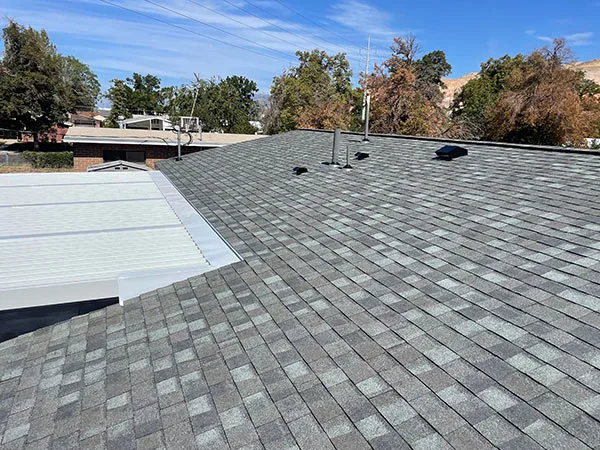
Branches, Canyon Wind and Scrubbed Shingles
A branch that hangs a foot above the roof on a calm day can be sitting on it once the wind picks up. In Millcreek that wind is no rarity. A hard canyon gust bends limbs down and drags them back and forth across the shingles.
That motion works like sandpaper. It strips granules, which are the part of a shingle that protects the asphalt from sun, and it can break the sealant bond along an edge so the tab lifts in the next gust. A lifted tab lets wind get underneath, and that is how a small scuff turns into missing shingles after a storm.
Bigger limbs are a separate worry. One that comes down in wind or under a snow load can crack the decking below the shingles as well, and that needs drying in quickly.
I am no arborist, and I will not tell you which limbs to take. I will show you photos of exactly where branches touch the roof, and you can hand those to whoever looks after your trees.
Why the October Leaf Drop Hits at the Worst Time
Every October the leaf load around Millcreek is heavy, and the timing is what makes it matter. The trees empty onto roofs and into gutters right before the first snow.
If those leaves are still sitting in valleys and gutters when winter arrives, they freeze into the mix. Snow melts off the warmer part of the roof, runs down to a gutter packed with leaves, and has nowhere to go. It sits at the eave and refreezes, and the ice builds back up under the lowest course of shingles. That is how an ice dam gets going, and the leak it causes often shows up as a stain on an outside wall or a ceiling near the edge of the house.
Gutters are a big piece of that story, and they get their own treatment on the Millcreek gutter replacement page. For a roof under sycamores the lesson is simpler. It wants a clean valley and a clear eave before the cold sets in, and a late-fall look is worth more than a spring one.
What I Check on a Roof That Lives Under Trees
On a roof under a big canopy, the assessment follows the water. Valleys first, then the uphill side of every chimney and skylight, then the eaves on the shaded slope, then anywhere a branch has been making contact.
I photograph what turns up in each of those spots: granule loss, lifted tabs, soft decking, flashing pulled away, debris packed where it should not be. You see every photo, and you get a plain read on whether the roof is handling the trees well or starting to lose ground to them. More often than not the fix is modest, and repairs are usually done in a visit.
If a branch strike or a hard wind has already done damage, that belongs with our Millcreek storm damage work, and routine fixes live on the shingle repair page. For how we cover the rest of town, see the Millcreek page, or look through our own finished roofs.
Quick Answers
Do I need to cut back trees before getting a new roof?
Not always, but it is worth talking through. Any limb that touches the roof in wind will wear new shingles the same way it wore the old ones. I can point out exactly where branches make contact and send you the photos, and an arborist can decide what to trim safely before the work starts.
Why is the shaded side of my roof darker, with frost and snow that stay longer?
Both come from the same cause: that slope stays cold and damp long after the sunny side dries. Dark staining is the surface holding moisture and grime, and frost or snow that lingers keeps meltwater sitting at the eave where it can refreeze. Neither is an emergency by itself, but that slope ages faster, so it is the first one I photograph.
When is the best time to have a roof under trees checked?
Late fall is my pick, once most of the leaves are down and before snow sticks. Valleys and eaves are at their most packed then, so problems are easiest to see. A second look after a big wind makes sense too, especially if you heard branches hitting the roof overnight.
Curious how your roof is holding up under the canopy?
I will climb it, follow the water from the valleys to the eaves, and photograph every spot the trees are wearing on. A late-fall visit like that is free.
Call (801) 750-4243or book a free roof assessmentPrefer to write? Describe the trees and the roof, and we will write back.
