
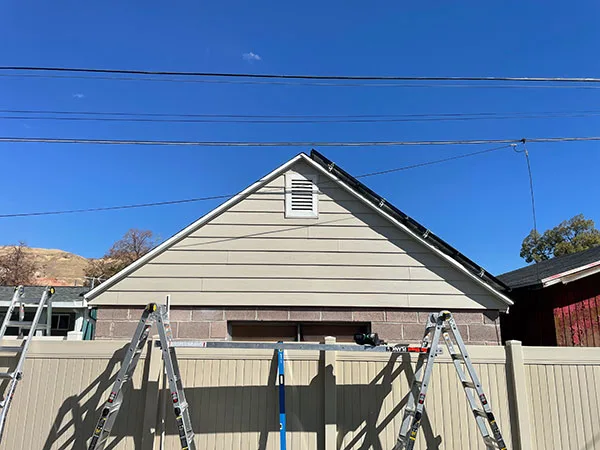
When Patching Old Siding Stops Making Sense
There comes a year when the wall itself is the problem. The color has gone chalky, every summer adds a crack, and the repairs are chasing each other around the house. Replacement resets the clock on the whole wall system, the barrier and flashing included, and it is the single biggest change you can make to how a house looks from the street.
How You Know It Is Time
Siding tells you when it is finished, if you know the signs. Vinyl that has gone brittle in our high-altitude sun cracks from bumps it used to shrug off, and the color rubs off on your hand like chalk. Wood-based panels swell at the bottom edges and hold paint for shorter and shorter stretches. Aluminum reads like a record of every hailstorm since the Olympics. And on any material, if the courses are wavy or fasteners keep working loose, the wall behind it is moving, holding moisture, or both.
The decade matters too. Most of the valley’s builder-grade vinyl went up in the nineties and two thousands, and it was priced to build subdivisions, not to survive thirty Utah winters. If your street is one of those, you have watched the neighbors replace theirs one windstorm at a time. Doing it on your schedule instead of the storm’s costs the same and lets you pick the material, the color, and the month.
There is also the quiet argument, the one we care about as roofers. Siding is the raincoat on four fifths of your house. Old cladding with opened seams and tired caulk lets small amounts of water reach the sheathing year after year, and that slow soak is what we find when walls finally get opened up. Replacement is the only moment the whole wall is visible and every hidden problem is cheap to fix. If the failures are still local rather than everywhere, the honest move is the siding repair page instead, and we will tell you so.
What goes back up is your call, and we will walk you through it plainly. James Hardie fiber cement and prefinished composite plank are what we recommend most on the siding installation page, and everything there about materials and flashing applies double when the whole house is getting done.

What a Full Re-Side Looks Like
Tear-off, all the way to the sheathing
Everything comes off, cladding, old felt or housewrap, tired trim, so the actual condition of the wall is visible for the first time in decades. This is where re-side jobs earn their money, because whatever we find gets fixed while fixing it is easy.
Sheathing repair while the wall is open
Soft and rotten sections get cut out and replaced with solid material. Old leak paths around windows and at rooflines get traced and corrected rather than covered. You see photos of everything we find, with a price, before we proceed. On most houses this list is short. On the ones where it is not, it is the part of the job you will be gladdest you did.
A new water management layer
Modern water-resistive barrier, taped seams, fresh window and door flashing, and kickout flashings at every roof-to-wall intersection. This layer is why a replacement outperforms a lifetime of patch repairs. It is also invisible on day two, which is exactly why you want a crew that treats it as the point of the job rather than a step to rush.
New cladding, trim, and the finished edge
Planks go up level and straight with the fastening and gaps the manufacturer calls for, trim goes on plumb, and the top edge ties into fascia and soffit work if the roofline is part of the project. Finished houses are in the gallery, and they are the best argument this page has.
Pair It With the Roof, or Not
If your roof is inside a few years of replacement, do the roof first and the walls right behind it. One mobilization, one dumpster, and the drip edge, step flashing, and kickouts get sequenced by one crew instead of negotiated between two companies. If the roof is young, siding stands alone just fine. We will tell you which order your house wants after one look, not sell you the bundle regardless.
Priced for the Whole House, In Writing
Royal Dane Roofing is a small residential outfit out of Salt Lake City, covering the towns on the service areas page. Jeremy measures the house himself and hands you one written number for the whole project, tear-off through cleanup. No allowances that balloon later, no surprise line items. Start on the contact page or call (801) 750-4243, Monday through Friday, 7am to 4pm.
Replacement Questions, Answered Straight
What does siding replacement cost?
It scales with wall area, material choice, the number of stories and corners, and how much sheathing repair the tear-off reveals. Fiber cement runs more than vinyl and buys decades of not thinking about it. We measure, we quote the whole job in writing, and the number holds unless hidden rot turns up, which gets photographed and priced separately before we touch it. Nobody enjoys surprises on the second day of a re-side, least of all us.
How long does a whole-house re-side take?
Most single-family homes run one to two weeks. Tear-off and wall repair set the pace early, then the new cladding moves quickly. Weather can shuffle days around in winter, but it rarely adds many. You get a schedule before we start and a heads-up the moment anything moves it.
Can I live in the house during the work?
Yes. The work is all exterior. It is noisy during the day, the yard hosts a dumpster and material for a week or so, and we ask you to keep pets inside while crews are on ladders. Beyond that, life runs as normal, and we leave the site picked up with a magnet run for nails every evening.
Will new siding actually help resale value?
It is consistently one of the stronger exterior returns, because it changes the first photo on the listing and calms the inspection at the same time. A buyer’s inspector who sees new cladding, new barrier, and clean flashing details has a much shorter report to write. We will not pretend to be realtors, but the houses we re-side do not linger.
What happens if you find rot under the old siding?
It gets photographed, priced, and shown to you before anything else happens. Small sections are a quick fix while the wall is open. What we never do is wrap new siding over known rot to keep a schedule. The point of tearing off is that nothing gets hidden twice.
Do you replace soffit and fascia at the same time?
Usually, and it is the right time to do it. The roofline trim frames every wall we re-side, old soffit next to new siding reads shabby fast, and doing it together means one scaffold setup and one flashing sequence. The soffit and fascia replacement pages cover the details, or just ask when you book the assessment.
