
Low-Slope Roofs That Actually Shed Water
Plenty of Salt Lake City houses have a flat section somewhere. A back addition, a covered porch, a garage roof, or a whole mid-century home built low and wide. Those sections fail differently than shingle roofs do, and they need a membrane or coating system built for standing water and long winters. Jeremy handles these himself, house by house, and he will tell you straight whether yours needs a full system or a coating that buys you another decade.
Water Does Not Run Off a Flat Roof. It Sits.
A pitched roof gets to be lazy about waterproofing because gravity does most of the work. Water hits it and leaves. A low-slope roof has no such luxury. Every seam, every flashing, every penetration has to hold water that is going to sit there for hours, sometimes days. That is the whole difference, and it is why a roofer who only knows shingles will get a flat section wrong.
Add Utah winter to that. Snow that slides off a steep roof in an afternoon will sit on your flat section for six weeks. It melts during the warm part of the day, refreezes overnight, and works its way into any seam that is not fully bonded. Freeze-thaw is patient. It will find the one lap the last guy rushed.
Then summer arrives and the same surface bakes under high-altitude UV all day long. Old asphalt-based flat roofing dries out, shrinks, and cracks. The membrane you install in this valley has to survive both ends of that swing.
The failure signs are usually easy to spot from the ground or a stepladder. Puddles that are still there two days after a storm. Blistering or bubbling across the field. Seams that have lifted at the edges. A drain or scupper choked with gravel and cottonwood fluff. Interior stains along the wall where the flat section meets the taller part of the house.
None of that means the whole thing is finished. Half the flat roofs we look at can be cleaned, detailed, and coated for years of added life. The other half have taken on water in the insulation, and coating over a wet roof just seals the problem in. Cutting a small test core tells us which one you have, and we would rather cut that core than guess.
If your problem turns out to be on the pitched part of the house instead, that is a different conversation. Start with shingle roof repair or a full roof replacement and we will point you the right way.

Two Honest Paths for a Low-Slope Roof
Full membrane replacement
When the roof has taken on water or the substrate is soft, everything comes off. We pull the old material, look at the deck, replace what is rotten, and rebuild the slope where it needs it. Then a single-ply membrane goes down, fully adhered or mechanically fastened depending on the deck and the exposure, with heat-welded seams and real termination detail at every wall and curb. Penetrations get proper boots rather than a tube of sealant and a hope.
This is the answer when the roof has been leaking for a while, when the insulation squelches underfoot, or when the previous repair was three layers of patch material stacked on top of each other. It costs more up front and it stops the bleeding permanently.
Clean, detail, and coat
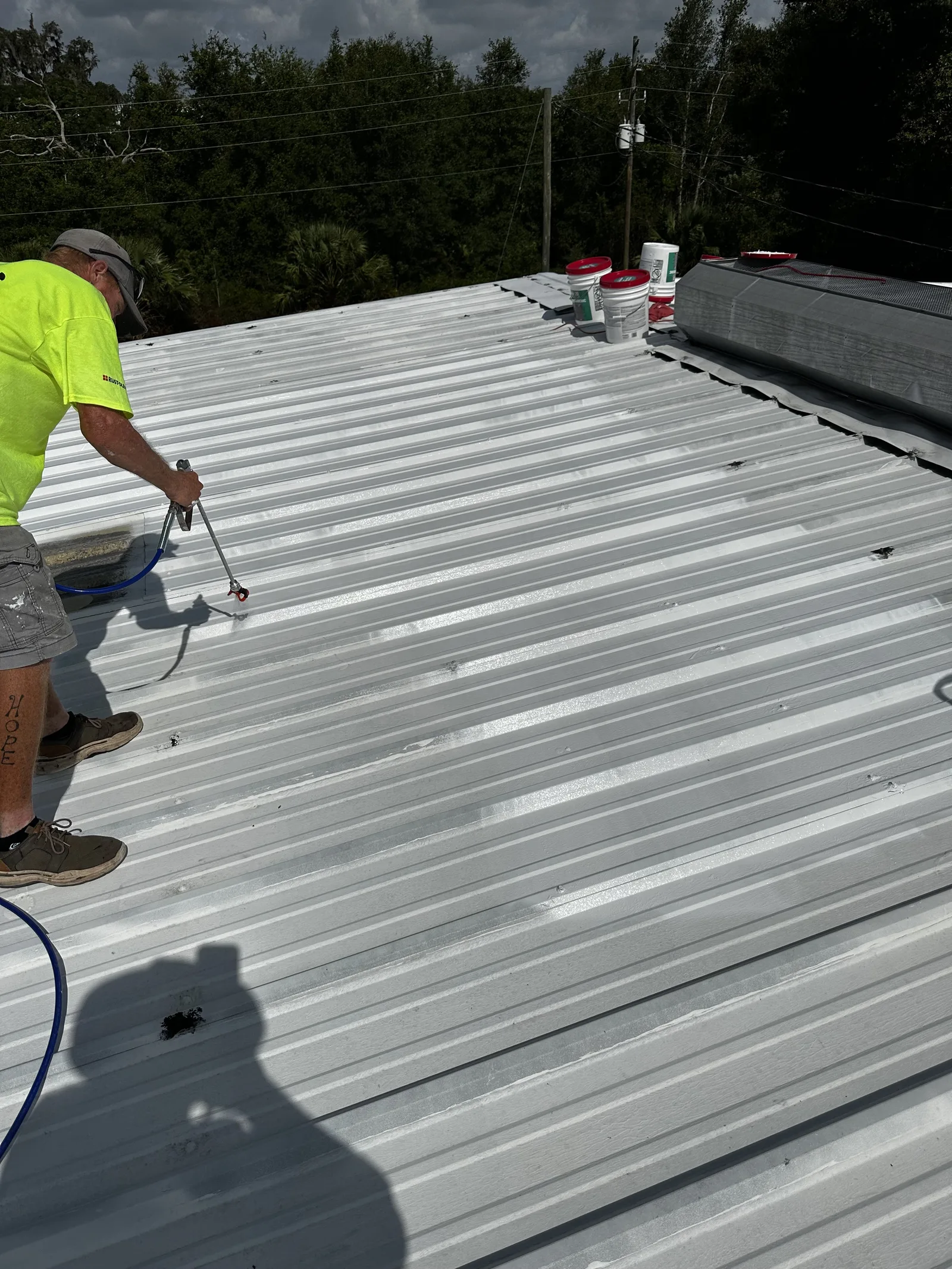
When the roof is dry underneath and the field is sound, an elastomeric or silicone coating system is the smart money. The surface gets washed, all the seams and flashings get reinforced with fabric and base coat, and then the field gets a monolithic coat that seals it edge to edge. No seams left to fail because the whole thing becomes one surface.
Silicone in particular handles ponding water better than almost anything else, which matters on a roof that will never drain perfectly. The white surface also reflects a serious amount of summer heat, which your upstairs rooms will notice in July. Coating is not a magic trick and we will not sell it on a wet roof, but on the right roof it is the best value in this trade.
Drainage comes first either way
Neither system fixes a roof that has nowhere to send water. Before anything else goes down we look at where the water is supposed to go and whether it can get there. That means checking the slope, clearing or adding drains and scuppers, and making sure the gutters below can actually take the volume. Sometimes the fix is tapered insulation to build slope into a dead-flat section. Sometimes it is as simple as a properly sized gutter replacement so the water leaving the roof does not pool against the foundation.
You can see finished low-slope work alongside our shingle jobs in the gallery.
A Small Company, on Purpose
Royal Dane Roofing is family-owned and residential only. Jeremy spent ten years on roofs and ran another company end to end before starting this one, and he is on every job we take. That is not a marketing line, it is just how a three-year-old company with a small crew works. We are not the biggest outfit on the Wasatch Front, which is exactly why every single job matters here.
Flat roofing rewards that. Low-slope work is detail work: the seam you did not roll, the flashing you cut a half inch short, the drain you did not clear before coating. Those mistakes do not show up the week you finish. They show up in February when a homeowner is standing in the kitchen watching a ceiling stain spread. When the owner is on the roof rather than a salesman in a truck, those details tend to get done.
We work Monday through Friday, seven to four, across Salt Lake County and out along the Wasatch Front. Check the service areas to see if your neighborhood is on the list, then get on the schedule and Jeremy will come look at it.
Flat Roofing Questions, Answered Straight
Do you do commercial flat roofs?
No. Royal Dane is residential only, on purpose. We work on houses: the flat addition off the back, the porch roof, the garage, the mid-century home that is low-slope from wall to wall. Keeping the work residential means we are set up for the access, the scale, and the neighbors that come with a house rather than a warehouse.
How much does a flat roof cost?
It depends on square footage, what is under the old material, whether the deck needs work, and whether you are a candidate for a coating or need a full membrane. A dry roof that just needs cleaning and coating is a very different number than a soaked roof coming down to the deck. Book a free roof assessment and you get a firm written price for your actual roof, not a range off a website.
Is standing water on my roof a problem?
Water that clears within about two days of a storm is normal on a low-slope roof. Water that is still sitting there a week later is telling you something: either the slope is wrong, a drain is blocked, or the deck has sagged. Long-term ponding accelerates seam failure and adds real weight. We look at slope and drainage before we quote any surface work, because a new membrane over a bad drainage plan just fails more slowly.
Can you coat a flat roof in winter?
Coatings need dry surfaces and temperatures above their cure minimum, so deep winter is usually out. We do most coating work from late spring through early fall. If your roof is leaking in January, we dry it in with a temporary repair and schedule the real work when conditions cooperate. Nobody benefits from a coating applied over a cold wet deck.
How long does a coating system last?
A properly prepped silicone or elastomeric system typically buys ten to fifteen years, and it can be recoated at the end of that rather than torn off. Prep is what decides it. A roof that got washed, had every seam reinforced, and received full-thickness coverage lasts. A roof that got a quick roll of product over dirt does not, which is why we will not do that version.
Does snow load matter on a flat section?
It does. Snow slides off a pitched roof and stays on a flat one, sometimes for months, and wet spring snow is heavy. That is a structural question as much as a roofing one. When we assess a low-slope section we look at deflection and at how the framing is holding up, and if something looks undersized we say so rather than laying a new roof over a problem.
