
Hail Hurts a Roof Long Before It Leaks
A hailstorm off the benches can bruise every shingle on a Salt Lake City house and leave the roof looking untouched from the driveway. Royal Dane Roofing gets on the roof, photographs what the stones actually did, and tells you plainly whether you are looking at a repair, a claim, or nothing at all. Jeremy does the inspection himself.
What Hail Actually Does to an Asphalt Shingle
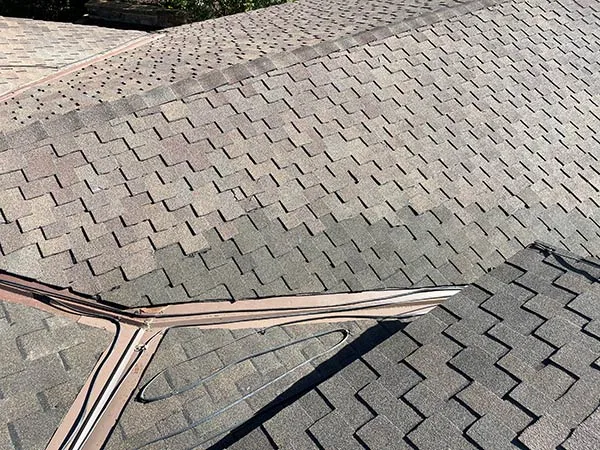
An asphalt shingle is three things stacked together: a fiberglass mat, asphalt saturating that mat, and a bed of ceramic granules protecting the asphalt from sunlight. Hail attacks all three at once. A stone hits hard enough to knock granules loose, and the asphalt underneath is suddenly exposed to Utah sun that will dry and crack it over the next couple of summers. The mat takes the rest of the impact, and where it bruises, the shingle has lost its structure even though the surface still looks fine.
A bruise is the one most homeowners never see. Run a thumb over it and the spot gives, soft and slightly dented, like a bruise on fruit. The granules may still be sitting there. The color may still match. Underneath, the mat fibers are broken and the asphalt has a fracture running through it that will open every time the temperature swings across freezing.
Then there is the cracking. Larger hail, an inch and up, can split fiberglass outright. Those cracks often run under the tab above, invisible from every angle except directly overhead with the shingle lifted.
Granule loss is the damage you can sometimes measure from the ground. After a real hailstorm, check the bottom of your downspouts. If there is a small pile of what looks like coarse black sand in the splash block, that came off your roof. A little granule shed is normal on a new roof and normal at the end of a roof’s life. A sudden pile the week after a storm is a different story.
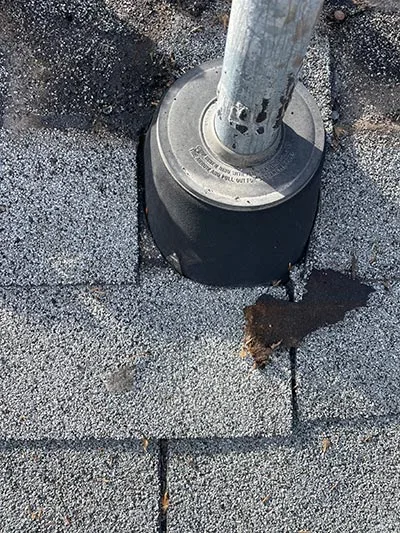
Hail also beats up everything that is not shingle. Soft metals show it first, which is why we always look at gutters, vents, valley metal, and pipe boots. Dents in an aluminum gutter face or a bruised vent cap are physical proof that stones of a certain size hit this specific address, and that matters if a claim ends up being the right call.
The honest summary is that hail damage is a clock, not a hole. It rarely leaks the day it happens. It shortens the life of the roof, and the leak shows up a year or three later when a bruised shingle finally splits. That is why we get eyes on the roof after a storm rather than waiting for a stain on a ceiling.
How We Inspect, and What You Get
Every hail inspection starts on the ground and works up. We walk the property first, checking gutter faces, downspouts, window screens, the AC condenser fins, fence caps, and any soft metal on the exterior. Those surfaces record the storm. If nothing on the ground took a mark, the roof usually did not either, and we will tell you that before we ever set a ladder.
Test squares, not a walk-around
On the roof we lay out test squares, generally ten feet by ten feet, on each slope. We count the hits inside each square and note the direction they came from. A hailstorm has a wind direction, so damage clusters on the slopes that faced it. A roof with heavy strikes on the south and west and nothing on the north tells a consistent, believable story. A roof with scattered marks in random spots usually tells us we are looking at foot traffic, blistering, or manufacturing flaws instead of hail.
Photos of everything, including the parts you would rather not see
Jeremy photographs each test square, each impact, the soft metal evidence, and the areas that are fine. You get the whole set, not a curated version. If half the roof is in good shape, that is in the photos too. It is your house and your money, and a documented inspection is only useful if it is complete. Finished work from other storm jobs is in the gallery if you want to see how repairs come out.
A plain recommendation at the end
You will get one of three answers. Either the roof is fine and you should do nothing, or there is localized damage worth a straightforward repair, or the damage is widespread enough that filing on your homeowner policy is the sensible move. We do not push the third answer to sell a bigger job. A large share of the hail calls we take end with a repair or with nothing at all, and we would rather be the roofer you call again in five years.
Repair, or a Claim?
This is the question that actually matters after a storm, and the answer comes from the roof rather than from a script. A repair makes sense when the damage is contained. A few dozen strikes on one slope, a cracked ridge cap run, a bruised patch around a vent. We match shingles as closely as the manufacturer’s current color run allows, replace the damaged pieces, hand-seal the courses we disturbed, and you move on with the rest of the roof’s life intact.
A claim makes sense when the damage is spread across enough of the roof that repairs would be chasing it. Insurers generally have a threshold of hits per test square, and once a slope is past it, they consider that slope no longer repairable to its prior condition. If your roof is in that territory, we say so, we document it thoroughly, and we walk you through what happens next on the roof insurance claims page. We meet the adjuster on the roof, we scope what is actually there, and we never inflate a claim or offer to cover a deductible. Both are fraud, both put the homeowner’s name on the paperwork, and both are common enough along the Wasatch Front after a big storm that you should be suspicious of anyone who suggests it.
Hail rarely travels alone. The same cell that dropped stones usually brought a hard gust front with it, so we check for lifted tabs and creased shingles while we are up there. If that is the bigger problem, start with wind damage roof repair. If the storm did enough that the whole system is compromised, storm restoration covers the full rebuild, and roof replacement covers what happens when a roof is simply finished. We serve homeowners across the valley and the surrounding counties, listed on the service areas page.
Hail Questions, Answered Straight
How do I know if my roof has hail damage if nothing is leaking?
You mostly cannot tell from the ground, and that is the whole problem with hail. Check your downspout splash blocks for a fresh pile of granules and look at gutter faces and vent caps for dents. Those are useful hints, but a bruised mat is only findable by hand on the roof. If a storm dropped stones the size of a dime or larger on your street, a documented inspection is worth doing whether or not you see anything.
How long after a hailstorm can I still deal with it?
Most Utah homeowner policies give you a window measured in months to a year from the date of loss, and the specific number is in your policy. Waiting works against you regardless, because once another storm rolls through, it becomes harder to prove which one caused what. The practical answer is to get the roof looked at within a few weeks of a storm you noticed.
Will filing a hail claim raise my rates?
That is between you and your carrier, and we will not pretend to speak for them. What we can tell you is that hail is a weather loss rather than a liability loss, and carriers generally treat those differently from an at-fault claim. Call your agent and ask directly before you file. We will give you the documented inspection either way, and there is no obligation attached to it.
Can you match my existing shingles on a repair?
Usually close, sometimes exactly. We install IKO architectural shingles as our standard and know their color runs well. Older roofs have weathered, so a fresh shingle will read slightly brighter for a season until the sun evens it out. On a repair we pull replacement material from the least visible slope when we can, so the patch ends up somewhere no one looks from the street.
A door knocker told me my roof is totaled. Should I believe him?
Get a second opinion from someone local who will show you photos. Storm season brings crews from out of state who work a neighborhood hard, promise to cover deductibles, and are gone by winter. We never waive a deductible or inflate a claim, because that is fraud and it lands on the homeowner. Jeremy has been on roofs for ten years and has run this company for three, and he is here in the valley when the roof needs something later.
What does the inspection cost?
Nothing. The roof assessment is free, the photos are yours whether or not you hire us, and there is no pressure attached. Book a free roof assessment or call (801) 750-4243 and we will get you on the schedule. We answer Monday through Friday, 7am to 4pm.
