
Metal Roofs Rarely Fail. Their Fasteners Do.
Panel almost never wears out. What loosens is the hardware and the sealant holding the details together, and both are repairable long before anybody needs to talk about a new roof. We fix metal roofs with matching panel and the correct sealants for the job, not a tube of caulk smeared across the problem.
What Actually Goes Wrong on a Metal Roof
Metal expands and contracts every single day of its life. A panel that bakes in July sun and sits at ten degrees in January moves measurably across its length, and that motion works on everything holding it down. Over ten or fifteen years the screws walk backward out of the deck a fraction at a time, the neoprene washers under their heads flatten and crack, and the sealant in the ridge and hip joints loses its stretch. None of that is a defect. It is just what happens, and it is why a metal roof needs occasional attention rather than none at all.
The good news is that these are small, targeted repairs on a roof that is otherwise sound. Somebody who knows metal can go up, sort out the hardware and the details, and leave you with another decade before anything needs a second look.
The bad news is what happens when the wrong person gets up there first. Metal repair gets butchered constantly by crews who only really know shingles. The tell is caulk. Long smears of the wrong sealant across a seam, roofing tar over a fastener line, mismatched screws driven into fresh holes beside the old ones. It hides the leak for a season and makes the correct repair harder and more expensive when somebody finally does it right.
Jeremy has ten years on roofs and runs every job this company takes. Royal Dane Roofing is small and family-owned, and that is the pitch: every job matters here. Send photos through the contact page or call and describe what you are seeing, and you will get a straight read on it.
The Repairs We Get Called For Most
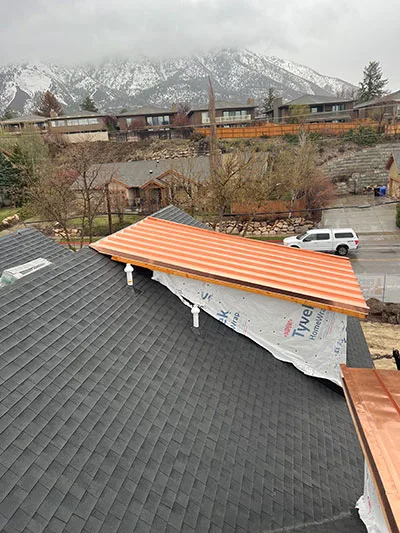

Fasteners backing out
The most common metal roof call in the valley, and usually the least dramatic to fix. Thermal cycling backs screws out over the years and the rubber washers under the heads harden until they no longer seal. We replace with oversize fasteners that bite fresh wood where the original hole is wallowed out, using new sealing washers rated for the exposure. Half measures here are why the same roof leaks again in two seasons.
Sealant failure at ridge and hip intersections
Where a ridge meets a hip, or where two runs of cap converge, the closures and sealant carry the whole burden of keeping weather out. That sealant lives a hard life under Utah sun. It shrinks, pulls away from the metal, and opens a hairline path that finds your attic. The correct repair pulls the old material out entirely, cleans the substrate, and rebuilds the joint with proper closures and butyl or the manufacturer’s specified sealant. Not a bead of caulk over the top of failed caulk.
Panel damage from limbs and wind
Falling branches dent, crease, and occasionally puncture a panel. Wind can lift an edge or work a seam loose on a run that was fastened light. Where a panel is compromised we replace that panel rather than patching over it, sourcing profile and color to match as closely as the original line allows. Older or discontinued colors will show some difference and we tell you that before we order, so nothing about the finished look is a surprise.
Flashing at chimneys, walls, and skylights
Metal roofs leak at the same place shingle roofs do: the transitions. Chimney flashing that was never properly counterflashed into the mortar, a sidewall detail without a real headwall diverter, a skylight curb sealed instead of flashed. This is the work that separates a metal roof done by a metal roofer from one done by whoever was available. See finished detail work in the gallery.
Oil canning, which is usually not a problem
Homeowners call about this more than almost anything, so here is the honest answer. Oil canning is the gentle waviness you see in the flat area of a metal panel, and it is an inherent characteristic of light-gauge metal, not a failure. It shows up more in bright raking light and on wide flat pans, and it does not affect performance or lifespan at all. If it is severe enough to trace to an installation problem, such as panels fastened too tight or over an uneven deck, we will tell you and explain what could be done. Usually the correct advice is to leave it alone.
When Repair Stops Being the Right Answer
Almost every metal roof we look at is worth repairing. The panel is sound, the failures are at the hardware and the details, and a day of correct work buys years. That is the outcome we are aiming for on every call, and plenty of the roofs homeowners think are finished turn out to need exactly this instead.
There is a point where the math flips. When an exposed-fastener roof has been re-screwed twice already and the deck no longer holds a fastener anywhere along a run, when rust has eaten through panel at the eaves rather than just staining the finish, or when a decades-old install used a system whose closures and trims are no longer made, replacement is the honest recommendation. We would rather lose the repair sale and tell you the truth than take money for work that fails next winter. When that is the call, a new metal roof or an asphalt replacement are both on the table and we will lay out the tradeoffs plainly.
If a storm caused the damage, whether that was hail off the benches or a wind event that lifted a run of panel, it may well be a claim. We photograph everything before touching it and meet the adjuster on the roof. Read how that process works on the insurance claims page.
We repair metal roofs on homes, cabins, shops, and outbuildings from Salt Lake County out through Davis, Weber, Utah, Tooele, and Summit counties, including the canyon properties where metal is most common. The full coverage list is on the service areas page. Reach Jeremy directly at (801) 750-4243, Monday through Friday, seven to four.
Metal Repair Questions, Answered Straight
My metal roof is leaking. Does that mean it needs replacing?
Rarely. Metal panel outlasts almost everything else on the roof, so leaks usually trace to backed-out fasteners, failed sealant at a ridge or hip, or flashing at a chimney or wall. Those are repairs. Jeremy gets on the roof, finds the actual entry point, and photographs it so you can see the problem yourself. Book a free roof assessment on the contact page and you will get a real answer instead of a guess.
Can you match my existing panel color?
Usually close, sometimes exactly. Current color lines match well. Older or discontinued finishes have faded under high-altitude sun for years, so a new panel beside them will read slightly brighter no matter what we order. We check the profile and color before ordering and tell you honestly what the result will look like, so nothing about the finished roof surprises you.
Why not just seal the leak with caulk?
Because it fails, usually within a season, and it makes the correct repair harder afterward. Metal moves constantly with temperature, so a rigid sealant cracks along exactly the joint it was meant to protect. Proper metal repair means removing failed material, cleaning the substrate, and rebuilding the detail with the right closures and a sealant made to stretch. It takes longer. It also lasts.
What does a metal roof repair cost?
It depends on what failed, how much of the roof it involves, and how steep and reachable the work area is. Replacing a run of fasteners is a different job than rebuilding chimney flashing or sourcing and swapping damaged panel. You get a firm written number after the on-roof assessment, and it holds unless we open something up and find more underneath, which we photograph and price before going further.
Should I be worried about the waviness in my panels?
Almost certainly not. That is oil canning, a normal visual characteristic of light-gauge metal that shows up in flat pan areas under raking light. It has no effect on how the roof performs or how long it lasts. If it is dramatic enough to suggest panels were overtightened or laid over an uneven deck, we will say so and explain the options rather than selling you a fix you do not need.
Do you work on shops, barns, and cabins as well as houses?
Yes. Exposed-fastener panel on outbuildings and mountain cabins is some of the most common metal we service, and it is where backed-out screws show up first because those roofs get the least attention. We are residential only, so a detached shop or a cabin in the canyon is squarely our work while a warehouse is not. Call (801) 750-4243 and describe the building.
