
One Long Ranch Eave, One Tired Downspout
On a Holladay ranch the eave can run the full width of the house, and every bit of that roof drains to one edge. Plenty of those gutters went up before anyone planned for the kind of winter the upper bench actually gets. Jeremy climbs up and checks the trough, the fascia it hangs on, and the soffit under it, then tells you plainly whether the run needs replacing or a smaller fix.
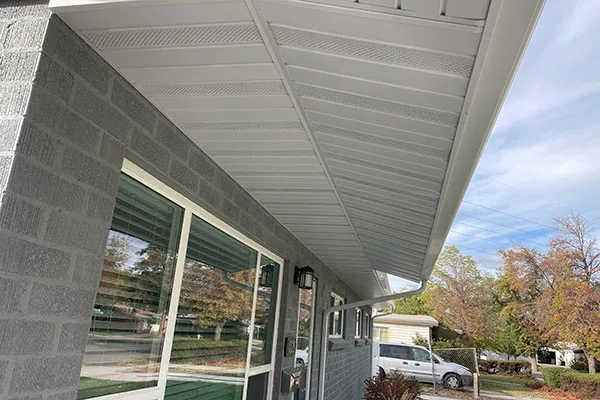
What a Wide Eave Asks of a Gutter
Walk around most of the fifties and sixties ranches in Holladay and the first thing you notice is how much eave there is. Those roofs are long and low. Rain and snowmelt off the whole front slope gather along a single eave, and the gutter hanging there has to carry all of it to a downspout all the way at the far corner.
Freeze-thaw is the other half of the story. Up on the bench, snow softens on the shingles in the afternoon sun and locks up again once the light goes. When the trough is shallow or full of leaves, that water stops at the edge and turns to ice. The ice builds backward under the first courses of shingles, and the leak shows up on a ceiling weeks later, far from where it started.
Length brings its own trouble. A trough stretched across a wide ranch has to slope the whole way to its outlet, and over a long run even a slight sag leaves a belly where water sits. In summer that belly just collects grit. In January it holds a bar of ice heavy enough to bend hangers and tip the front of the gutter away from the roof.
So we treat the eave as one assembly. Shingles lap over a drip edge, the drip edge sheds into the trough, the trough is fastened to fascia, and the soffit underneath lets the attic breathe. When one piece gives out, the next one follows. A gutter that has spilled over its front lip for years almost always means soft fascia, and wet fascia tends to leave a stained or sagging soffit right below it.
The newer custom rebuilds around town bring their own gutter plans, some well thought out and some drawn mostly for looks. We judge every one of them the same way: by where the water ends up during a real storm.
And sometimes the metal is perfectly fine. If rehanging a sagging section and resealing a corner takes care of it, the job gets written up as a gutter repair and the rest of the run stays on the house.

Taking the Eave Apart in the Right Order
Figure out what drains to each run
A long ranch eave collects water from a lot of roof. We work out the area feeding each section, note any valley that empties into it, and size the trough and outlets for a fast spring melt. Copying the old gutter size is usually how the old problem returns.
Pull the old gutter and read the board behind it
Once the old run is down, the fascia tells the story. We press along it, look for dark streaks and backed-out nails, and photograph every soft spot. Rotten wood is cut out and replaced with sound lumber before a hanger goes back up, because fresh aluminum screwed into punky fascia just pulls loose again in a winter or two.
Look at the soffit while it is exposed
On most ranches the soffit is how the attic takes in air. If the vents are stained, sagging, or painted over, the attic runs warm, and a warm attic melts snow from underneath. We make sure the vents are open and the panels are solid. A perfect gutter under a starved attic still ends up full of ice.
Send the water somewhere useful
A big lot gives you options a tight one does not. Rather than dropping runoff beside the foundation, we place outlets where the ground falls away from the house, and add a second drop when one corner is handling too much of a long run. On a wide ranch that usually means moving the old downspouts, and the reasons are right there in the photos.
Be straight about heat cable
Shaded eaves and north corners can hold ice no matter how well the gutter is built. Heat cable run across the shingles and down through the trough keeps meltwater moving in those spots. It treats the symptom. If the photos point to heat escaping the attic, that problem goes on the list ahead of any cable.
Hang it, seal it, clean up
Hangers go into solid wood at close spacing, the trough gets a steady fall toward each outlet, and seams are sealed while the metal is clean and dry. Then the magnet sweep goes through the lawn and flower beds, and the old gutters leave on our truck.
Finished eave and roof work is in the gallery if you want to see how the lines come out.
When the Shingles Above Are Tired Too
Look under an eave that has spilled over for a few winters and the wall usually gives it away: streaked paint, a swollen corner board, trim gone soft at the bottom. That damage gets its own line under siding repair, since new gutters stop the soaking but cannot dry out a rotten board. A ceiling stain a few feet in from the outside wall is a different animal. When the water is getting in higher on the slope, shingle roof repair is the fix, and the gutter may be innocent.
The roof edge ties all of it together. Drip edge, starter course, and ice and water shield sit right where the hangers go, so gutters hung this fall under shingles due for a tear-off next summer would have to come down again. If the photos show a roof in that spot, the order is your decision, and doing the gutters along with a roof replacement builds that edge once. A trough crushed by a bench hail cell, or a run a gust peeled off the fascia, is photographed as found and handled as storm damage repair.
What to Watch From the Lawn
You can do some of the looking yourself. During a heavy rain, walk the length of the house and watch where the water leaves the gutter. A sheet pouring over the front lip, a steady drip from one seam, a downspout that gurgles and backs up, or a stripe of bare dirt under the eave each tell us where to start once we are on the roof.
In winter the clues change. Icicles hanging from one stretch of eave and nowhere else, or a gutter that sits visibly lower at one end, usually mark the bad section of a long run. Snap a phone photo when you see it, because the ice is often gone by the time anyone climbs up.
We get to Holladay regularly from Salt Lake City, and more about the roofs we see around town is on the Holladay page. Book an assessment and mention what you spotted, or call (801) 750-4243.
What People Ask Us About Holladay Gutters
Why do my gutters overflow at one corner and stay dry at the other?
On a long ranch eave the trough often pitches the wrong way or feeds a single downspout that cannot keep up. Water piles up at the low spot and spills over the front. Correcting the pitch or adding a second outlet usually solves it, and we check which one your house needs.
Does the soffit have anything to do with my gutters?
More than most people expect. Soffit vents feed air to the attic, and a warm, poorly vented attic melts snow that then freezes at the gutter. Overflow also rots the fascia sitting right above the soffit. We look at all three together because they tend to fail together.
Can the downspouts move away from my patio or driveway?
Usually, yes. A downspout can be relocated to another corner, turned with elbows, or given an extension that carries water past a patio, walkway, or driveway where ice would form. On a larger lot there is often a spot where the ground drops off. The trough then has to pitch toward wherever the new outlet lands.
Can you tell if my fascia is rotten before the gutters come down?
Usually we get a good idea by pressing along the board, looking for stains below the gutter, and checking for loose hangers. The full picture comes once the old run is off. Any soft wood gets photographed and shown to you before it is replaced, so there are no surprises.
Is it smarter to wait and do gutters with a new roof?
If the roof has only a few years left, usually yes, since the gutters and the roof edge are built together. If the shingles are sound and the gutters are failing now, there is no reason to wait. The assessment shows where your roof stands so you can plan the order.
How much will new gutters cost for my house?
It comes down to the length of your eaves, how many downspouts the lot needs, and whether fascia or soffit work has to happen first. We do not guess from the driveway. After the free roof assessment you get a written number for your house, and nothing starts until you agree to it.
