
Ice Dams Are Not a Gutter Problem. They Are an Attic Problem.
Every January I get the same call. There is a ridge of ice sitting on the gutter, icicles hanging off the front of the house, and a brown ring on the ceiling above the living room window. The homeowner has already decided what happened. The gutters must be clogged, or the wrong size, or they need to come off and be replaced with something better. Almost every time, the gutters had nothing to do with it.
I have been on roofs for about ten years and I have run my own shop for three of them. Ice dams are the one winter failure where the visible damage and the actual cause sit on opposite ends of the building. The stain is on your ceiling. The ice is on your eave. The problem is usually eight feet above both, in an attic you have not opened since you moved in. It is just physics, and once you see the mechanism you can usually point at your own house and tell me where the heat is getting out.
The Short Version
- Ice dams form because the upper roof deck is warm and the eave overhang is cold.
- Heat leaking into the attic melts snow from underneath, even on a day that never gets above freezing.
- That meltwater runs down, hits the overhang past the exterior wall, and refreezes.
- The ice builds into a dam, water pools behind it, and pooled water goes under the shingles.
- Heat cable manages the symptom and costs you money every winter it runs.
- The fix order is air sealing, then insulation, then balanced intake and exhaust ventilation.
What Is Actually Happening Above Your Ceiling
Snow lands on the roof and sits there. Underneath it, your roof deck should be about the same temperature as the outside air. In a healthy attic it is, because whatever heat sneaks in gets flushed out before it can warm the plywood.
In an attic that is leaking heat, the deck over the heated part of the house climbs above freezing. Snow touching that deck melts from the bottom up. You never see it happen. The top crust stays frozen and looks fine from the driveway while a thin film of water runs down the underside of the snowpack toward the eave.
Then that water crosses the exterior wall line and gets out over the overhang. There is no heated space under an overhang. It is outdoor air above and below. The water hits that cold section and freezes, and the next batch freezes on top of it, and by the third or fourth cold night you have a ridge of ice two or three inches tall at the roof edge.
That ridge is the dam. Everything that melts after it forms has nowhere to go, so it ponds behind the ice and sits on the roof. Asphalt shingles are lapped like fish scales to shed water moving downhill. Give them water standing still and slightly uphill of the lap, and it walks up under the course above and finds the deck. From there it takes the path of least resistance into your wall cavity or across a ceiling joist until it shows up as that brown ring.
Why Your Neighbor’s Roof Is Clean and Yours Is Not
People assume it is the shingle brand or the age of the roof. It is usually not. I have looked at two houses on the same street in Kearns, same builder, same year, same shingle, and one dammed up every winter while the other never did. The difference was inside. The house that dammed had can lights punched through the ceiling, a whole-house fan with no cover, and a pull-down attic ladder with a quarter-inch gap around the frame. Every one of those is a chimney for warm indoor air, and insulation only slows conduction, so loose fill over an open can light just hides it.
The other thing I see constantly on Wasatch Front homes is a bathroom exhaust fan dumping straight into the attic. Somebody remodeled a bathroom, ran the flex duct up through the ceiling, and stopped. Now every shower pumps warm wet air onto the underside of your roof deck. That is heat and moisture at once, which gives you a dam in winter and mold on the sheathing the rest of the year, and it is almost never on the homeowner’s radar.
Roof shape plays into it too. A simple gable with open soffits the whole way is the easy case. Add a couple of dormers, an intersecting hip, a garage tying into the main roof at a lower pitch, and you get pockets of attic with no airflow at all. Those dead pockets warm up first and they are usually the exact spot where the ice starts. When I walk a house and the ice is only in one twelve-foot stretch, I already know which part of the attic I am headed for.
Where Heat Cable Fits, and Where It Does Not
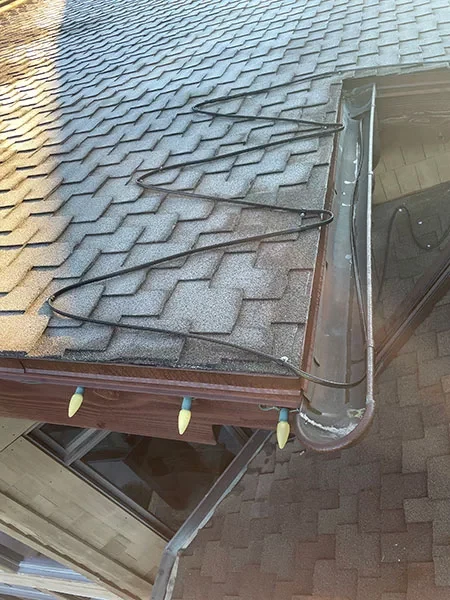
I am not against heat cable. I install it. But I want to be straight about what it does. Heat cable does not stop the melting on your upper roof. It melts a channel through the ice at the eave so the water behind the dam has somewhere to drain. You are paying for electricity to fight a problem being created above the cable, every hour it is plugged in, every winter, forever.
Where it earns its keep is on the parts of a roof you genuinely cannot fix any other way. A dormer with a tiny triangle of attic behind it and no path for airflow. A cathedral ceiling with no room for a vent channel. A north-facing section shaded by a big tree. On those, cable in the gutter and the downspout, run on a thermostat instead of left on all season, is the honest answer.
What I will not do is sell you cable as the whole solution on a straightforward vented attic. If somebody quotes you cable without ever going into your attic, they did not diagnose anything. Same goes for gutters. New ones will not stop a dam, because the dam forms on the roof surface above the gutter and would form on a house with no gutters at all. Gutters do get destroyed by ice, and if yours are pulled loose it is worth looking at what can be repaired. Just do not let anyone tell you the gutters caused it.
The Fix, In the Order That Actually Works
Air sealing comes first, always. Every penetration between the heated house and the attic gets sealed. Can lights get airtight covers or sealed fixtures. The attic hatch gets weatherstripping and a rigid foam cap. Plumbing stacks, wire penetrations, interior wall top plates, the chase around the furnace flue, all of it gets foam or caulk depending on the gap and the fire clearance. Unglamorous work, and the highest-value thing you can do.
Insulation comes second, once the air is stopped. A lot of the houses I go into on the west side of the valley have six or eight inches of settled fiberglass that was fine in 1978 and is not fine now. Depth over sealed penetrations gives you a real thermal break. Depth over unsealed ones gives you a warm attic and a receipt.
Ventilation comes third, and it has to be balanced. Air comes in low at the eave through soffit vents and leaves high at the ridge, with intake at least matching exhaust. When that loop works, outside air washes the underside of the deck and keeps it cold, which is what you want in winter and what keeps shingles from cooking in July. The longer explanation is on the roof ventilation page.
Here is the part people get backwards. If you add exhaust vents without opening up the intake, the attic still has to pull air from somewhere, and the easiest place is the house. Now your ridge vent acts like a chimney sucking heated indoor air up through your ceiling penetrations and dumping it on the deck. I have seen dams get measurably worse after a ridge vent went on a house with soffits painted shut. More exhaust with no intake is not more ventilation. It is a vacuum pointed at your living room.
What We Do Before We Quote Anything
I go in the attic. That is the whole difference. I look at the underside of the deck for staining, frost, or rust on the nail shanks, because rusted nail tips tell me warm moist air has been hitting cold metal all winter. I check whether the soffit vents are open or buried under blown insulation. I look for that bathroom duct. I check whether the ceiling penetrations line up with where the ice is forming outside.
Then I look at the roof itself. How far up did the water get under the shingles. Is there ice and water shield at the eave. Is the sheathing soft anywhere. Sometimes the answer is a targeted shingle repair plus attic work, and the rest of the roof has years left. Sometimes the deck is gone in the first three feet and we need a bigger conversation about replacing the roof with proper eave protection built in.
I would rather tell you your roof is fine and your problem is a bathroom fan than sell you a roof you did not need. If you have got a stain on your ceiling right now, do not wait for spring. The water already found a path and it will use the same one every thaw. Send us the details and we will get in the attic and tell you what we actually see.
Quick Answers
Can I just knock the ice off the roof myself?
Please do not get on a ladder in January to chip ice with a hammer. I have seen people put a hatchet through the shingles and turn a leak into a hole. If you need relief right now, pull snow off the lower four or five feet with a roof rake from the ground. Do the real diagnosis when the weather breaks.
My roof is only six years old. Why is it damming?
Age has very little to do with it, because the mechanism is heat escaping from your house, not shingle wear. What a newer roof usually has is ice and water shield at the eave, and that membrane is a safety net rather than a cure. It keeps backed-up water off your ceiling for a while. The dam is still forming.
Will more insulation by itself solve it?
Sometimes, if your attic is already well sealed and simply thin on depth. More often it helps without finishing the job, because the heat getting up there rides on moving air rather than conducting through the ceiling. Insulation does almost nothing against a can light pushing warm air past it. Seal first, then add depth.
How do I know if my soffit vents are blocked?
Go in the attic during daylight with your flashlight off and look toward the eave. You should see daylight at the edge. A wall of insulation instead means your intake is buried. The fix is usually baffles, rigid channels stapled between the rafters that hold insulation back and keep an open path to the ridge.
Does homeowners insurance cover ice dam damage?
It depends on the policy and the carrier, and I will not pretend I can read your declarations page for you. Many policies cover sudden interior water damage while excluding the attic correction, since that reads as maintenance. Photograph everything, dated, before anybody touches it. We work with adjusters regularly on the insurance side.
Get someone in the attic before you get a bid.
If ice is stacking on your eave every winter, the answer is up there and it takes a flashlight and about twenty minutes to find. We will look, tell you plainly what is causing it, and give you the options in order of what actually fixes it.
Call (801) 750-4243or book a free roof assessment
Want proof first? The gallery is all our own work.
