
Why Metal Makes Sense on the Benches, and When It Doesn’t
Drive east out of the valley on a February morning and you can watch the roofs change. Down on the flats around Kearns, where our shop is, the snow is already gone by noon and half the driveways are dry. Twenty minutes uphill in Cottonwood Heights or up above Holladay toward the canyon mouths, the same storm is still sitting on the roofs three days later, wet on the bottom and crusted on top. Same city, same week, completely different job for a roof.
I have spent ten years on roofs and three running my own shop, and the bench neighborhoods are where I get asked about metal more than anywhere else. Here is the honest version. Metal is genuinely better up there for reasons that have to do with snow, wind, sun, and fire. It also has real drawbacks that a lot of people selling it will skip past, and on plenty of bench houses a good shingle roof installed properly is the smarter buy. I will tell you that at your kitchen table if that is what I think.
The Short Version
- Bench and foothill homes see deeper snow, harder canyon wind, and more UV than the valley floor. All three are hard on a roof.
- Metal sheds snow instead of holding it, which reduces ice damming and takes weight off the structure.
- Standing seam hides its fasteners under the seam. Exposed fastener panels are cheaper and need gasket maintenance every so often.
- Wind performance comes from the fastening schedule and the clip spacing, not from the fact that the panel is metal.
- Snow shedding is a feature until it lands on a walkway, a car, or a gas meter. That is what snow guards are for.
- Metal costs more up front and takes a crew that actually does panel work. On some houses a shingle roof is the better call.
What the benches actually do to a roof
Elevation is the whole story. Bench neighborhoods catch more storm total than the flats, and they hold it longer because the shade patterns are different and the nights are colder. A roof up there stays loaded for days, and that loading is what drives ice dams. Snow sits on the deck, heat leaking out of the attic melts the underside of it, the water runs down to the cold eave, and it freezes again. Do that for a week and you have a ridge of ice at the edge of the roof with standing water backed up behind it. Shingles shed water moving downhill; they do not hold a pond, so that water gets under the courses eventually. That is how a bench house ends up with a stain on the bedroom ceiling in March with no visible damage anywhere on the roof.
Then there is the wind. Canyon wind is a different animal from valley wind. It comes down out of the mouths in gusts with real force behind it, and it does not arrive politely from one direction all afternoon. It hits the eave, gets under whatever edge it can find, and lifts. On houses in Emigration or up above Sandy toward Little Cottonwood I have pulled shingles that were fine everywhere except the windward rake, where the tabs were curled back like a book cover.
And then the sun, which nobody thinks about because it does not feel like an event. At bench elevation the roof takes more UV than a house at the same latitude near sea level, every clear day of the year. UV dries out the asphalt in a shingle mat and takes the flexibility out of it. A shingle roof on a south-facing bench slope simply does not live as long as the same roof on a north slope in the valley.
Where metal earns its money up here
Start with the snow, because it is the biggest one. A metal panel is slick, and it warms in the sun faster than a granulated shingle does. A thin film of melt forms between the snowpack and the panel, and the whole load lets go and slides off before it can build a dam at the eave. On a bench house with a steep pitch and southern exposure I have watched a foot of snow come off in one piece by ten in the morning. That also takes weight off the structure, which matters on older bench homes framed to an older code.
Wind is the second one, and here I want to be precise, because it gets oversold. Metal is not inherently windproof. It resists uplift because of how it is attached: concealed clips fastened into the deck on a set spacing, with the seam locking the panel edges together so wind cannot get a fingerhold the way it does under a shingle tab. Space those clips right and detail the eave, rake, and ridge properly and you have a roof that laughs at canyon gusts. Space them wrong and you have an expensive kite. The panel is not what saves you. The fastening schedule is.
Third is longevity under sun. Metal has no asphalt mat to dry out. A modern painted panel carries a factory finish built to hold color and resist chalking under exactly the UV load the benches deliver. It fades, but it does not get brittle and start losing granules the way a shingle does around year fifteen on a hot slope. If you plan to be in the house for the long haul, that changes the math on the whole purchase, which is worth talking through when we look at what a full replacement involves.
Fourth, and this one matters more every year: metal does not burn. Homes right up against the foothills sit in what people call the wildland urban interface, which is a technical way of saying your back fence and the mountain are the same thing. Wind-carried embers landing on a roof are the most common way a house catches during a brush fire. An ember on a metal panel does nothing. That is not a small thing when the air is orange in August.
Standing seam and exposed fastener are not the same purchase
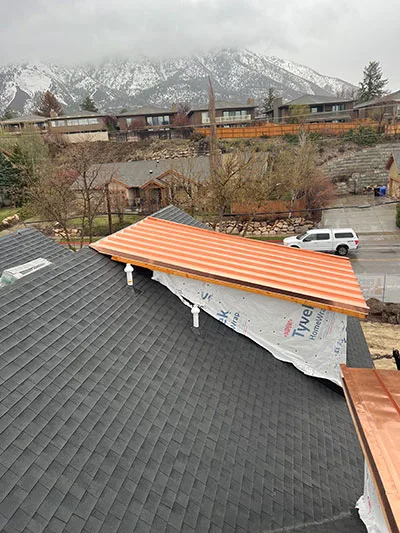
People say “metal roof” like it is one product. It is two very different ones, and the difference shows up in the price and in how you live with it. Standing seam is what most people picture: long vertical panels running eave to ridge with raised ribs where they join, and the clips holding it down hidden inside those seams. Nothing penetrating the panel field is exposed to weather, so there is no gasket in the sun waiting to fail, and the panel is free to move. It is the premium option, and it costs more because the panels are formed to length and the trim at every valley, rake, and penetration is fabricated rather than pulled off a shelf.
Exposed fastener panel, sometimes called ag panel or R panel, is the corrugated-looking stuff you see on shops and barns and on plenty of houses. It screws straight through the face of the panel into the deck or purlin, and every one of those screws has a rubber washer under the head making the seal. It goes on faster and costs less, which is why it exists.
Here is the part nobody mentions at the sale. Those washers are the roof. They sit face-up in bench sunlight all year, and rubber in UV hardens and shrinks. The panel also moves with temperature while the screw does not, so every hot day and cold night works the hole a little larger. Sooner or later screws back out or washers crack, and you have hundreds of small holes in your roof. An exposed fastener roof needs somebody walking it every few years, tightening what is loose and replacing what has gone hard. That is normal ownership, not a defect, but you should know it going in rather than finding out from a ceiling stain. It is straightforward work, and a good part of what we do on metal roof repair calls.
The tradeoffs I make sure people hear
Snow shedding is the best thing about metal and it is also the thing that hurts people. When a bench roof lets go of its load, that snow goes fast and all at once. If it lands over your front door, over the gas meter, or over where you park, that is a genuine hazard. I have seen a slide take out a gutter run and bend a downspout flat. The fix is snow guards: small brackets or a continuous rail mounted on the panel to break the sheet up so it comes off gradually instead of in one slab. They are not optional on a bench house with entries and drives under the eaves. If a bid does not mention them, that tells you how carefully the roof was looked at.
Second, two things metal does that shingles do not, both of which come down to the crew. Metal moves with temperature, and a long panel might see over a hundred degrees of swing between a January night and a July afternoon. Standing seam handles that because the clips let the panel slide; fasten a long panel rigidly at both ends and it fights itself until something gives, usually the fastener holes or the seam. The other is oil canning, the gentle waviness you see in the flat of a panel at a low angle. It is inherent to flat sheet metal, it happens on good installs with good product, and it is cosmetic. Heavier gauge, narrower panels, and a clean deck reduce it. Nothing eliminates it, so if it will bother you every time you pull in the driveway, I would rather say so now.
Third: sound, which gets exaggerated. A metal roof over a solid deck with underlayment and insulated attic space below is not meaningfully louder in rain than a shingle roof. The barn-roof drumming people remember comes from panel over open purlins with nothing underneath. That is not how we build a house roof.
The layers under the panel matter more than the panel
If you take one thing from this, take this. The metal is the part you see and the part everyone shops. It is not the part that decides whether your roof leaks. The deck comes first, because metal telegraphs everything under it. A dip, a proud seam, a soft spot in old sheathing, all of it shows as a shadow line down a panel forever, and it makes oil canning worse. On a tear-off we walk the whole deck and replace what is soft before anything goes down. You cannot fix that later.
Then underlayment. On a bench house I want a high-temperature ice and water membrane at the eaves running well past the interior wall line, because metal gets hot under sun and standard peel-and-stick can soften and lose grip against a hot panel. That eave membrane is the actual insurance against an ice dam, on any roof material. Metal makes dams less likely. It does not make the eave detail optional.
Then flashing. Every valley, every chimney, every sidewall, every pipe boot. Most of the leaks I get called out to look at are not the field of the roof failing. They are a flashing detail somebody rushed, or reused, or caulked instead of formed. On metal this is more demanding, not less, because you cannot slip a piece under a course of shingles and call it good. It has to be fabricated to fit.
And then ventilation, which is invisible and gets skipped constantly. A roof that cannot breathe cooks its own underside in summer and drives ice damming in winter, because a warm attic is exactly what melts the snowpack from below. Balanced intake at the soffit and exhaust at the ridge keeps the deck at outdoor temperature where it belongs. We treat attic ventilation as part of the roof, and on bench houses it is often the real root cause of the problem somebody called us about.
When I tell a homeowner to buy shingles instead
I would rather do a shingle roof right than a metal roof for the sake of doing a metal roof, and there are a few situations where I say so plainly. If you are not staying in the house long, the math usually does not work, because metal earns its premium over decades. Five years from selling, a quality architectural shingle roof with proper eave protection and real ventilation protects the house and puts your money somewhere you will get it back. IKO makes shingles I am comfortable putting my name on, and a good one on a bench house is not a compromise. It is a sound roof.
If the roof is cut up badly, metal gets expensive fast and gets riskier. Six dormers, three chimneys, a couple of skylights, and valleys running everywhere means an enormous amount of hand-fabricated flashing, and every one of those transitions is a place where a mediocre installer creates a leak. Shingles are far more forgiving on complex geometry. That is not me talking myself out of work. That is me not wanting to hand somebody a roof with forty chances to fail on it.
And if what you have is a decent roof with a specific problem, the answer might not be a new roof at all. Plenty of what we do is targeted shingle repair, a bad valley rebuilt, a chimney reflashed. I would rather fix the broken thing and have you call me in eight years than sell you a replacement you did not need yet. If you are not sure which camp your roof falls into, have me come out and look at it before you start collecting bids. Every job we take has my name on it, so I care about the job more than the sale.
Quick Answers
Will a metal roof really stop ice dams on a bench house?
It makes them far less likely, but it is not a guarantee by itself. Dams start with heat escaping into the attic and melting the snowpack from below. If your attic is under-ventilated, you can still get ice at the edge, especially on a shaded north slope. That is why we look at the attic before we talk about the panel.
Are snow guards required, or are they an upsell?
Required in practice on almost any bench home where a slope drains over an entry, a walkway, a driveway, or a utility meter. A slab of wet Wasatch snow off a two-story slope has real weight and real speed behind it. Guards break it up so it comes off in pieces. If a bid does not raise the question, nobody looked closely at where your snow goes.
What is oil canning and does it mean something is wrong?
It is the gentle waviness you sometimes see in the flat area between the ribs, usually when light hits at a low angle. It is inherent to flat sheet metal and shows up on well-installed roofs with good material. Cosmetic only, no effect on performance. Heavier gauge and narrower panels reduce how visible it is. Nothing removes it entirely.
How often does an exposed fastener metal roof need attention?
Plan on somebody walking it every few years. The rubber washers under each screw head are what seal the roof, and they take UV all year while the panel moves around a fixed screw. Catching hardened washers early is an afternoon of work. Ignoring it for a decade means hundreds of small openings and a wet deck.
Can metal go over my existing shingles to save on tear-off?
Sometimes it is allowed, and I usually advise against it. Going over old shingles means you never see the deck, so you have no idea whether there is soft sheathing underneath. It also traps moisture and makes a flat, true plane harder to get, which shows up as extra oil canning. On a roof meant to last decades, I want to see what it sits on.
If you are weighing metal against shingles, let me look at the roof first.
I will walk it, get in the attic, look at your ventilation and your eave details, and tell you plainly which one I would put on my own house at that address. Sometimes that is metal. Sometimes it is a good shingle roof and a fixed valley. Either way you get a straight answer from the person who will be on the job, and the visit does not cost you anything.
Call (801) 750-4243or book a free roof assessment
Want proof first? The gallery is all our own work.
