
Flat Roofs Are Not the Problem. Standing Water Is.
There is a stretch of Sugar House and Liberty Wells where half the houses have a low-slope section on the back, usually over an addition somebody built in the sixties or a porch that got enclosed later. I get called out to those roofs constantly, and almost every homeowner opens with the same sentence: flat roofs always leak. They do not. What leaks is a flat roof with a puddle sitting on it in November that is still sitting there in March, frozen solid.
The reputation is earned, I will give people that. There are a lot of bad low-slope roofs in this valley. But the reason they are bad is almost never the membrane material and almost always the water that has nowhere to go, plus somebody who tried to solve that with a bucket of black goo instead of fixing the slope.
So let me walk through what a low-slope roof is actually doing, why standing water is the thing that decides its life in a snow climate, and what I look at when somebody calls me about the flat section on the back of their house.
The Short Version
- A properly built flat roof is not flat. It is pitched slightly, usually a quarter inch of fall per foot, so water leaves.
- Water that sits is the real enemy. It finds seams, it freezes, it expands, and it works the roof apart.
- Snow load is a structural question on low slope, because nothing sheds off it on its own.
- Most low-slope leaks are at a transition or a penetration, not out in the open field of the membrane.
- Roof cement smeared over a seam is a temporary patch, and it makes the real repair harder later.
- Drains and scuppers need to actually be clear and actually be at the low point. Both get missed.
Nothing on your house is truly flat
The trade calls it low slope, and the distinction matters. A steep roof sheds water because gravity does the work, and shingles are just overlapping scales that keep the water moving downhill. Below a certain pitch that stops being true. Water slows down, wind can push it sideways and uphill under an overlap, and a lapped system starts to fail. That is the line where you switch to a membrane, meaning a continuous waterproof surface with sealed seams rather than overlapping pieces.
But a membrane still needs the water to leave. The standard target is a quarter inch of fall per foot of run, which over a twelve foot addition is three inches from the high side to the low side. That is enough to move water to a drain or an edge without being visible from the yard. When somebody frames a low-slope roof dead level to save framing lumber, or when the framing sags over decades, you get ponding, and ponding is where the trouble starts.
The rule of thumb I use on an inspection is simple. Forty-eight hours after rain, in decent weather, the roof should be dry. If there is water standing after two days of sun, that spot is a low point that needs to be corrected, not just recoated. You can usually see the history of it even when the roof is dry, because ponding leaves a dirt ring and a lighter or darker stain on the membrane exactly where the water sat.
Why standing water is worse here than in a mild climate
Anywhere in the country, standing water on a roof is bad. It is heavy, it grows biological gunk, it degrades most membranes with prolonged UV and moisture together, and it magnifies any weakness in a seam. Along the Wasatch Front you get all that plus the freeze-thaw cycle, and the freeze-thaw cycle is a machine for taking things apart.
Here is the physical version. Water gets into a seam or a small opening in a lap, or under a flashing edge, during a warm afternoon. Overnight the temperature drops well below freezing, which it does here from late fall into spring, and that water turns to ice and expands. Ice takes up about nine percent more room than the water it came from, and it does not care what is in the way. The opening gets slightly bigger. Next warm day, more water gets in, a little deeper this time. We can run that cycle dozens of times in a single Salt Lake winter, and the inversion makes it worse because the valley floor can sit near freezing for days while the sun works on the roof surface itself.
Then add snow. On a pitched roof, snow eventually slides or melts off the edge. On a low slope, it just sits there. A foot of settled snow is real weight per square foot, and wet spring snow is much heavier than the dry powder people picture. Now add the meltwater that cannot drain because the drain is under the snowpack and frozen, and you have a load nobody planned for sitting on framing somebody built in 1962.
That is why I care so much about drainage on these roofs specifically. Everything bad that happens to a low-slope roof in this climate starts with water that did not leave.
Where these roofs actually leak
Homeowners picture a hole in the middle of the roof. I can count on one hand the times the leak was out in the open field of a membrane with nothing around it. Almost every low-slope leak I find is at a transition or a penetration, and there are five usual suspects.
First, the wall transition. Where the low-slope roof meets the vertical wall of the main house, there has to be a flashing that goes up the wall a good distance and gets counterflashed or tucked under the siding. This is the number one failure point on residential low slope, because it is the one detail that requires somebody to think. When it is done by wrapping the membrane a few inches up the wall and running a bead of caulk along the top, it will leak, and the water will show up inside the house well away from the actual entry point.
Second, penetrations. Plumbing vents, furnace flues, swamp cooler curbs, and the little conduit somebody ran for a light. Each of those is a hole in a waterproof surface that has to be sealed with a proper boot or a curbed and flashed detail. Swamp coolers are their own category in this valley, because they sit on a curb, they have water in them all summer, and half of them were installed by somebody who was not a roofer.
Third, the drain or scupper. If the roof drains through the deck to an interior pipe, that drain assembly has a clamping ring that has to grip the membrane properly. If it drains to a scupper through the edge, that opening needs to be lined and flashed. And either one needs to actually be at the lowest point of the roof, which sounds obvious and is violated all the time on additions where the framing settled after the roof was built.
Fourth, the edge. The perimeter metal on a low-slope roof holds the membrane down at its most vulnerable line and gives wind nothing to grab. Wind uplift on a low slope pulls at the edges first, exactly like it does on a shingle roof in canyon wind, and a loose edge lets the whole assembly start to peel.
Fifth, previous repairs. I find more leaks caused by old fixes than by original construction. Roof cement, the black tar in a bucket, is the usual culprit. It works for a season. Then it dries, shrinks, cracks, and pulls at whatever it is stuck to, and because it is opaque and covers everything you cannot see what is happening underneath. Now the real repair requires scraping all of it off first.
The membranes, in plain terms
People want to know which material is best, and the honest answer is that the detail work matters more than the material choice on a residential roof this size. That said, here is what you are likely looking at.
The old built-up roof, layers of felt and asphalt with gravel on top, is what a lot of older Salt Lake additions still have. It can last a long time and it can be repaired, but when it goes it usually goes broadly, and finding the leak under gravel is genuinely difficult work.
Modified bitumen is asphalt sheet goods reinforced with a fiber mat, installed in rolls with the seams heat welded or applied with adhesive. It is tough, it handles foot traffic well, and the granulated surface holds up to our UV. It is a good fit on a lot of these small residential sections, and it is forgiving to detail around odd shapes, which residential roofs are full of.
Single-ply membranes, the white or gray sheets you see on commercial buildings, are welded at the seams and go down as one continuous surface. On a residential low-slope section they work well when the roof is a simple rectangle. The white surface also reflects a lot of summer heat, which matters more than people think on a room that sits directly under it.
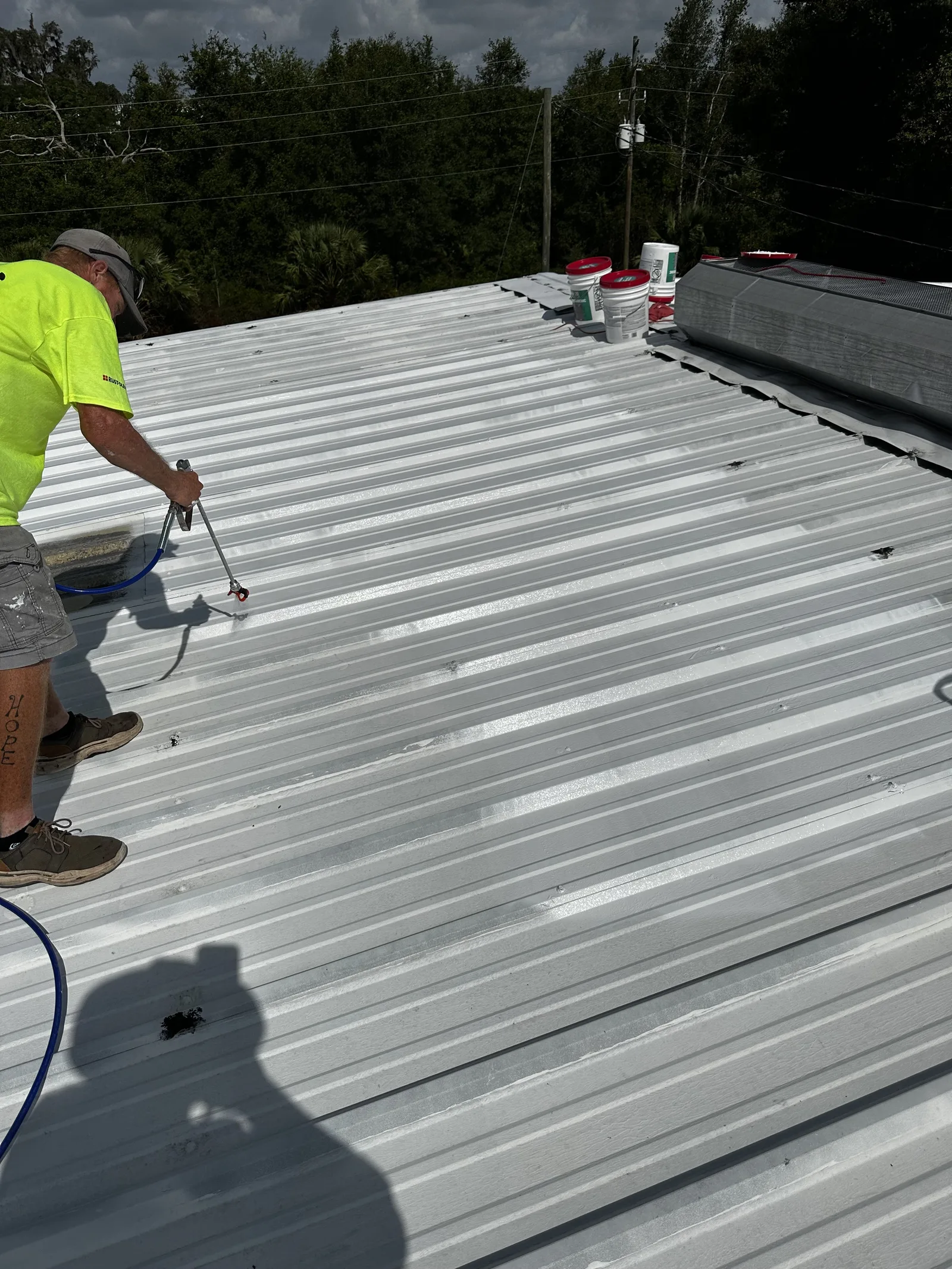
Fluid-applied coatings are the fourth option and the one most often misused. Over a sound roof with real drainage, a coating extends life and seals up minor aging. Over a roof that ponds, a coating is a cosmetic layer on top of an unsolved problem, and it hides the evidence you need to diagnose the actual failure. If somebody proposes a coating without ever talking about where your water goes, that is the tell. What all of this actually involves on your house is on the flat roofing page.
What I do when I get called out to one
I start inside, not outside. Where is the stain, how big is it, is it growing, is the drywall soft, is there a pattern to when it appears. A stain that only shows after a snowmelt is telling me something different than one that shows in a hard rain. Then I get in whatever attic or joist space I can access with a flashlight and look at the underside of the deck for staining and rot, because the wood tells the truth about how long this has been going on.
Then I get on the roof and I look at the low spots first, then every transition and penetration in order. I check whether the drain is clear and whether it is even at the low point. I press on the membrane looking for soft spots where the insulation or deck underneath has gone wet, because a wet substrate feels spongy in a way a dry one does not. I pull back the edge metal where I can to see how the perimeter was actually terminated.
And then I tell you what I think, including when the answer is small. A lot of these calls end with a properly rebuilt wall flashing, a new boot on two vents, and a clean drain, and the homeowner keeps that roof for another decade. That is not me being generous. That is me not wanting to sell somebody a whole membrane when the wall detail was the problem all along. If the deck is wet across a wide area, or if the roof has no fall built into it at all, then we are talking about a real rebuild with tapered insulation to create the slope, and I will show you why on the roof before I say it at the table.
I would rather do one honest repair on your addition and have you call me in eight years than talk you into a job you did not need. If you have a low-slope section acting up, have me come look at it before the snow flies, and while I am up there I will tell you what shape the rest of your roof is in too. You can see plenty of our own work in the gallery, which is all jobs we did ourselves.
Quick Answers
How long should a residential low-slope roof last here?
It depends far more on drainage and detail work than on the material. A membrane that drains properly and has correctly built wall flashings and penetrations will go a very long time in this climate. The same material over a roof that ponds every winter will fail early no matter what it cost. When somebody quotes you a lifespan without ever discussing where your water goes, take the number lightly.
Is standing water on my flat roof an emergency?
Not an emergency, but it is a defect worth correcting rather than living with. The benchmark is that the roof should be dry within about forty-eight hours of rain in decent weather. Persistent ponding adds weight, accelerates aging in that exact spot, and gives freeze-thaw cycling something to work on all winter. It is the root cause behind most of the low-slope failures I get called to.
Can I just have a coating sprayed over it?
Over a structurally sound, well-draining roof with tight details, a coating is legitimate maintenance and buys real time. Over a roof with ponding, wet insulation, or a failed wall flashing, it is a cosmetic layer that hides the evidence and delays the actual fix. I will tell you which situation you are in before anybody quotes a coating.
Should I shovel snow off my flat roof?
Usually no, and please do not go up there yourself in winter. Low-slope membranes are easy to damage with a metal shovel, and roofs are dangerous when they are wet and cold. If the depth genuinely worries you, call somebody who does it with plastic tools and leaves a protective layer of snow rather than scraping to the membrane. The better long-term answer is making sure the drains are clear before winter starts.
Why does my ceiling stain show up far from where the roof is bad?
Because water travels once it is inside. It runs along the top of the deck, down a rafter, across a ceiling joist, and comes out at the first low seam in the drywall it finds. On low slope this is especially common at the wall transition, where water enters high on a wall and surfaces several feet away inside the room. Finding the entry point takes tracing it back, not guessing from the stain.
Let me find out where your water is actually going.
I will check the low spots, every wall transition and penetration, the drain, and the underside of the deck, then tell you whether you are looking at a repair or a rebuild. Most of the time on these roofs it is a repair.
Call (801) 750-4243or book a free roof assessment
Want proof first? The gallery is all our own work.
