
Reading Spring Hail on an Older Starter-Home Roof
A spring squall rolls across the west side of the valley, drops hail for a few minutes and moves on toward the mountains. By evening the yard is dry and the roof looks the same from the sidewalk as it did that morning. Whether it really is the same takes a ladder to answer.
West Valley City has one of the largest stocks of sixties through eighties starter homes in Utah, and plenty of them have already been through a few of these storms. Some still carry three-tab. Others got architectural shingles at a later reroof.
This is the order I check a roof in after hail, and why the metal parts come before the shingles. The West Valley City page covers the rest of what we do in town.
Shortlist
- Dents in thin metal show hail of real size came through.
- A bruise gives under a thumb; a scuff sits only on the surface.
- Older three-tab and newer architectural shingles show hits differently.
- Wind behind the storm can lift tabs the hail already weakened.
- Nothing gets touched until it has been photographed.
Soft Metal Tells the Story First
Before I study a single shingle, I walk the roof and look at everything made of thin metal. Box vents, the collars around pipe boots, drip edge and the gutters all take a dent where hail struck them, and those dents stay put. A shingle can hide a hit. Aluminum cannot.
The pattern matters as much as the count. Dents on the west face of a box vent and nothing on the east face tell me which way the storm came in, and that tells me which slopes to search hardest. Dents on every vent say the hail was big enough to go looking for shingle damage. A clean set of vents usually means the shingles came through fine as well.
Gutters and downspouts get the same look from the ground. Spatter marks on a painted downspout, where the hail knocked off dust and chalky oxidation, show clearly in the days after a storm and fade within weeks. That is one reason I would rather see a roof soon after the hail than in late summer.
Bruises, Granule Loss and Plain Scuffs
On the shingles themselves I am looking for three different things, and only one of them is real hail damage. A bruise is a hit that cracked the mat under the granules. Press it with a thumb and it gives, a small soft spot that feels different from the shingle around it. Over a season or two the granules wash out of that spot and the asphalt underneath starts to cook in the sun.
Granule loss on its own is less clear. Every roof sheds granules as it ages, and a gutter with a layer of them in the bottom is normal on an older house. Loss that sits in round marks, with dark mat showing in the middle, is a hit. Loss spread evenly across a slope is the roof getting old.
Scuffs are the third thing, and the one most often oversold. Foot traffic, a dragged ladder or a branch can mark the surface without breaking anything underneath, and a scuff does not give under a thumb. I circle each spot in chalk and photograph it, so you can see the difference for yourself.
Three-Tab and Architectural Take Hail Differently
An older three-tab shingle is thin, and after a few decades on a sunny slope it has gone stiff. Hail on that shingle tends to crack it or knock a corner off a tab, which is easy enough to spot once you are up there. The catch is that the same roof often has age cracks that have nothing to do with the storm, and those have to be sorted out honestly.
A newer architectural shingle is thicker and laminated, so a hit that would crack three-tab might only bruise it. That damage hides well, which is why the thumb test matters more on these roofs, and why a glance from a ladder at the eave misses most of it.
On a house where the roof was replaced in sections, or patched after an earlier storm, each section gets checked on its own. Two shingle types on one roof can take the same storm in two very different ways.
When the West Desert Wind Follows the Hail
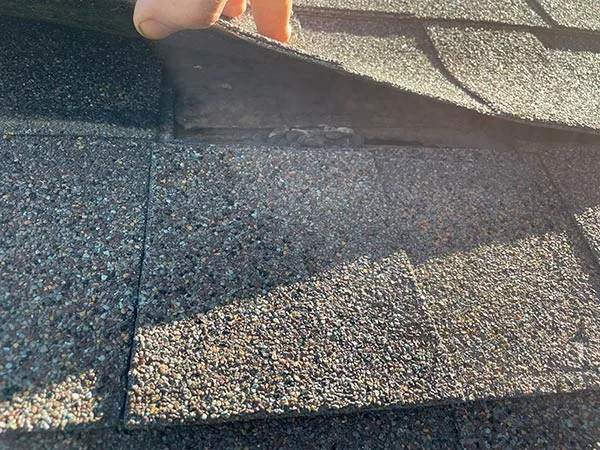
Spring squalls on this side of the valley rarely arrive alone. Wind comes off the west desert with a long run at the houses, and it often keeps blowing after the hail has stopped. A tab that took a hit, or a shingle that never sealed properly when it went down, gives that wind something to grab.
What I look for is a tab that lifts too easily, a seal strip that has let go, or a crease across a shingle where the wind folded it back. A creased shingle carries a weak line even after it lies flat again, and it tends to tear loose in the next blow. Rakes and the ridge get extra attention, because those edges catch the wind first.
That is why hail and wind get checked together. A roof can come through the hail with nothing broken and still lose shingles a month later because the storm loosened the seal. Photos of lifted tabs belong in the same record as the hail marks.
Repair a Slope, Replace the Roof, or Leave It Alone
A hailstorm does not automatically mean a new roof. If the hits are scattered on one slope and the rest is sound, repairing that slope can be the right answer, provided a close shingle match can be found. If damage runs across every slope, or the roof was near the end of its life anyway, replacement beats patching. And sometimes the roof took the storm with no real damage, which is exactly what you hear from me when that is true.
Whichever way it goes, everything is photographed before anything is touched. Those photos are the record, for you and for an insurer if a claim makes sense. The hail damage work we do in West Valley City starts with that walk, and if the damage is worth claiming, the insurance claims page explains what comes next. Book an assessment and I will go over the roof with you, photos in hand.
Hail Questions From Starter-Home Owners
How soon after a storm should the roof be checked?
Sooner is better. Spatter marks on metal fade within weeks, and wind can finish loosening a damaged tab before you notice anything inside. A check in the first week or two gives the clearest picture. If water is already coming in, call the same day so the roof can be dried in first.
Can I spot hail damage from the ground?
Sometimes on the metal. Dented gutters, a dinged downspout or a dented vent cap are all good reasons to call. The shingles are another story. A bruise on an architectural shingle is invisible from the yard and hard to see even from the eave, so most real damage only shows up from on top.
Does a dented gutter mean my shingles are damaged?
Not on its own. Thin aluminum dents from hail that a sound shingle shrugs off. Dented metal tells me the storm was worth checking for and which direction it came from. Whether the shingles took damage is a separate question, answered by going over them one slope at a time.
Hail Came Through? Have Jeremy Walk the Roof.
I check the metal, every slope and the seal along the edges, then hand you the photos and a plain answer on what the storm did. The assessment is free.
Call (801) 750-4243or book a roof assessment onlineCurious about our finish work? See the gallery.
