
Where the Low Roof Meets the Pitched One
Plenty of West Valley City starter homes picked up a low-slope section somewhere along the way: a back addition, a carport, a patio cover tied onto the house. Those roofs hold water and snow for days instead of shedding it, and the weak spot is almost always the seam where they join the shingles. Royal Dane Roofing treats that low section as part of the whole roof, and Jeremy tells you plainly whether it needs a membrane, a coating or neither.

Low Sections Added After the House Was Built
Most houses here started out with a plain pitched roof. Over the decades owners added a family room, closed in a patio or put a carport beside the driveway, and a lot of those additions went on with a roof that is close to flat. Some were built carefully. Some were clearly a weekend project.
The catch is that a low roof and a shingle roof play by different rules. Shingles shed water by overlapping, so they depend on water moving downhill fast. A low roof cannot count on that. Water sits, snow sits, and the surface has to stay watertight on its own, with seams that hold while they are soaking wet.
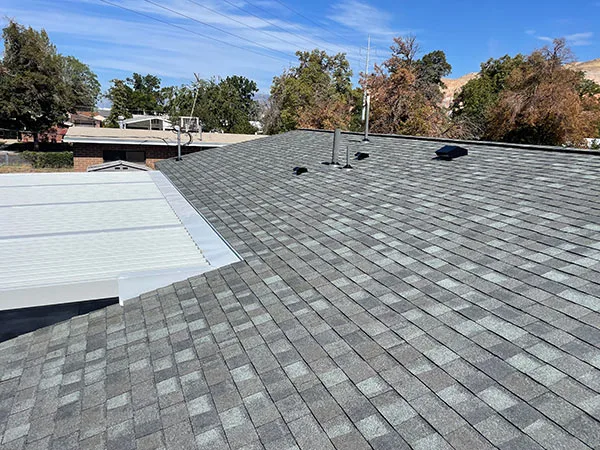
Where an addition meets the original house, you often find two rooflines joined at a valley that was improvised on the spot, with shingles lapped over a strip of roll roofing or a piece of flashing tucked under a course and caulked. That joint is the first place Jeremy looks when one of these roofs leaks.
Winter is hard on all of it. Snow drifts onto a low roof and stays put, and each thaw spreads water across the surface toward the seams. At night it freezes again. Water that crept into a seam during the afternoon expands overnight, and a seam that was barely open grows a little wider every cycle.
Wind is the other pressure. With open west desert upwind of the city, gusts cross the valley with room to build, and a membrane edge that was never properly terminated gives them something to catch. Once air gets under a loose edge, it can peel back far more roof than you would expect.
The main flat roofing page goes deeper on our systems. Here, the focus stays on the additions, carports and patio covers that turn up on West Valley City houses.
Membrane or Coating, Said Plainly
Finding out what is underneath
Before anyone talks about materials, Jeremy has to know whether the roof is dry. A low section that has been leaking for a while often hides wet insulation or soft decking under a surface that still looks fine from the ladder. When there is any doubt, he cuts a small test core and patches it, because that answer decides everything after it.
When a membrane is the right call
If the old roof has taken on water, or the deck underneath has gone soft, it all comes off. We replace bad decking, correct the slope where water has been pooling in one spot, and lay a single-ply membrane with heat-welded seams and proper detail at every edge and wall. It is more work up front, and on a wet roof it is the only fix worth paying for.
When a coating is enough
A dry roof with a sound surface can be a good candidate for a coating system. The surface gets cleaned, the seams and flashings get reinforced with fabric, and the whole field is coated into one continuous skin. Jeremy will not put a coating over a wet roof, though. All that does is lock the water in.
Tying low into pitched
The joint between a low section and a shingle slope gets rebuilt rather than smeared with another bead of sealant. The low roof’s surface turns up the slope under the shingles, metal flashing goes in, and the shingle courses above lap over it, so water always lands on top of the layer below. Where the old valley was improvised, we build a real one.
Carports and patio covers
Carports and patio covers sit low and out of mind, so they get ignored until a ceiling board stains or a post starts to rust. Some are metal panels, some are rolled roofing over plywood. We will tell you whether yours is worth reroofing, whether only its connection to the house needs work, or whether it is fine as it stands.
Spring Squalls and the Water That Stays
Hail rides in with the spring squalls, and a low roof takes it face up. Membranes can bruise or puncture, coatings chip, and metal patio covers dent. If a storm has already come through, the hail damage page walks through how we check for it, and the insurance claims page covers getting it documented before anything is touched.
Drainage matters as much as the surface. A low roof has to send its water somewhere: a scupper through the edge, a gutter on the low side or a drain in the field. Gutters on many of these houses were sized for a milder climate than the one West Valley City actually gets, and a gutter that overflows at the edge of a flat roof pushes water back toward the seams. We follow the water all the way off the roof.
If a low section runs across attached units, the townhome roof repair page explains how we handle a shared roofline. Additions can also change how the attic over the main house breathes, which falls under roof ventilation.
The Owner Climbs Up Himself
On a low roof the mistakes are small and quiet: one seam not fully welded, one edge fastened a little short. They wait for the next thaw to show themselves.
A low roof also gives no warning from the yard. Nobody can see its surface from the ground, so it gets looked at only when something drips inside. Having Jeremy check it while he is up on the main roof catches the small things early.
That is why we stay small. Jeremy does the free assessment himself, comes back with our regular crew, and stays on the job until the last edge is sealed. You see photos of the low section and the roof it ties into before anything is decided, and the price comes to you in writing.
West Valley City is part of our regular Salt Lake County route, and the West Valley City page collects the rest of our work here. Reach us through the contact page or call (801) 750-4243. Finished low-slope and shingle work is in the gallery.
Low-Slope Roof Questions From Homeowners
Is standing water on my flat roof a problem?
Some water after a storm is normal on a low roof. Water that is still there long after everything else has dried, or that always gathers in the same spot, points to a sag, a blocked drain or a slope that was never right. Standing water wears out seams faster.
Should I coat my flat roof or replace it?
It depends on what is under the surface. A dry, sound roof is often a good candidate for a coating system. A roof with wet insulation or soft decking has to come off, because coating over moisture traps it. Jeremy checks first and tells you which one he would choose for his own house.
Why does my addition leak where it meets the house?
That joint is where two roofs built at different times, and at different pitches, have to share water. On many additions the valley or flashing there was improvised, and it opens up after enough freezes. Rebuilding that tie-in properly is usually what stops the leak.
Can you roof a carport or patio cover?
Yes. Carports and patio covers get the same assessment as the main roof. Some are worth a new membrane or coating, some only need their flashing to the house redone, and some are fine as they are. Jeremy tells you which, and he will not push work a cover does not need.
Can flat roof work be done in winter?
Membranes and coatings need dry surfaces and workable temperatures, so most full jobs wait for warmer, drier weather. An active leak does not wait. We dry it in with a temporary repair whatever the month and schedule the real work for when it can be done properly.
Does a low roof need its own drainage?
It does. A low roof cannot rely on slope alone to move water, so it needs a clear way off: a scupper, a gutter along the low edge or a drain in the field. If that path is blocked or undersized, water backs up toward the seams. We check drainage before touching the surface.
One Roof, Both Pitches
Jeremy will walk the low section and the shingle roof it ties into, check what is underneath, and tell you whether it needs a membrane, a coating or nothing at all yet. The roof assessment costs you nothing, and the price comes on paper.
