
Siding Replacement for the House You Plan to Keep
When the old siding is split, swollen along the bottom course or chalking off on your hand, patching one more board does not buy much. Replacement is the one chance to fix what was never behind it: a real weather barrier, windows flashed the right way, and a clean line where the wall meets the roof. We lead with James Hardie fiber cement, use vinyl where it suits the house, and Jeremy runs the job from tear-off to the last piece of trim.
Older Siding Usually Tells You When It Is Done
A lot of the siding on Murray’s older houses went up decades ago, and it shows its age in a handful of predictable ways. Wood lap siding splits, cups and stops holding paint for more than a couple of seasons. Hardboard, the pressed-wood lap siding that was everywhere for years, swells at the bottom edges once water gets into it, and that swelling never goes back down. Old aluminum dents in hail, chalks in the sun and starts to rattle loose at the nails.
One bad board is a repair. When the same failure turns up on every wall, you are paying to patch a material that has reached the end, and the money goes further on new siding. Jeremy will tell you which side of that line your house sits on, and if a repair will do, that is what you will hear from him.
Most of what we see in town falls somewhere between the 1940s cottages near State Street and the nineties two-stories, and the siding on both has often been painted, patched or partly re-sided at least once. Each round of fixes leaves another seam for water to find.
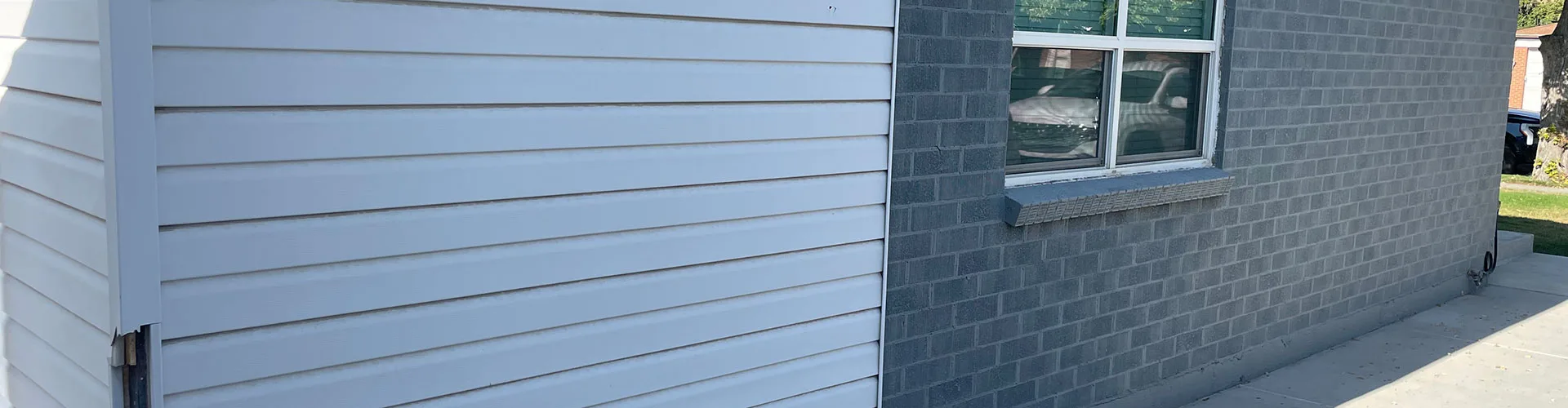
Then there are the half-and-half ramblers, brick up to the windowsills or across the front, with siding on the gables and upper walls. The joint between those two materials is where we find the most trouble. Water runs down the siding, hits the top of the brick, and if nothing is there to throw it outward, it soaks into the wall right at the seam. On a part-brick house the new siding gets a flashed transition, so water leaves the wall where the materials meet and the brick below stays dry.
We are a small company, and that matters on a job this size. The person who walks your walls and writes the number is the same one who is there when the old siding comes off and the wall underneath gets its first daylight in decades. The rest of our work around town, from roofs to gutters, is listed on the Murray page.
From Bare Sheathing Back Out to Finished Trim
What the tear-off shows
Pulling the old siding is the one time anyone gets to see the wall itself. We look at the sheathing for soft spots and staining, especially under windows and along the bottom course where splash and snow sit against the house. On older houses we often find tired felt paper behind the siding, and sometimes nothing at all. Anything rotted gets photographed and shown to you before it is priced and replaced.
Housewrap the old siding never had
Before a single new board goes up, the wall gets a continuous weather barrier, lapped from the bottom up so water running down it always lands on the layer below. It is a small part of the job compared to what it protects, and it lets the siding work as a rain screen. The old wall asked the siding to be the only thing between the weather and your framing.
Windows flashed in the right order
Window openings are where most wall leaks begin. Each one gets flashing at the sill, the sides and the head, tied into the housewrap so every layer sheds onto the one beneath it. Older siding usually leaned on a bead of caulk around the trim, and caulk in high-altitude sun gives up long before the siding does.
Gable ends and their vents
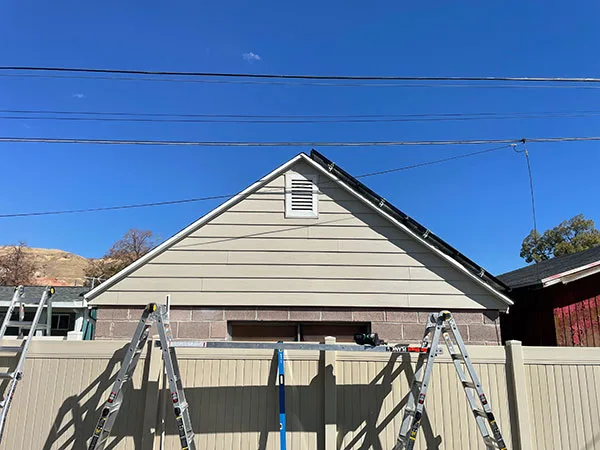
Gables are where the walls meet the attic. A louvered gable vent is part of how the house breathes, so it gets trimmed and flashed around at full size, never covered over or shrunk to make the siding easier to run. If the attic needs more airflow than the gable gives it, the roof ventilation page for Murray covers the exhaust side, and the soffit repair page for Murray covers the intake under the eaves. Finished walls and gables are in the gallery.
Fiber Cement First, Vinyl Where It Fits
James Hardie fiber cement is what we recommend on most re-sides. It stays straight when it gets wet, it will not soften near a grill or under the glare off a neighbor’s window, and it holds its finish well in hard sun. It also shrugs off hail far better than old aluminum ever did. Our siding installation page goes deeper into the material and how it gets fastened and flashed.
Vinyl still earns its place. On a gable above brick, an upper wall that is awkward to reach, or a house where the owner wants the least upkeep possible, a good vinyl over proper housewrap is a sensible choice. We lay out both for your walls and let you pick, and the general siding replacement page explains how a whole-house job gets scoped.
Color is part of the choice too. Fiber cement can come prefinished from the factory or go up primed and get painted on site, and the trim at the windows, corners and gables does not have to match the body. Whatever you are leaning toward, look at it outside against your brick and your roof before you commit, because a color chip under store lighting rarely looks the same on a west wall.
Book the Walls While the Roof Is Scheduled
If your roof is due or already on the calendar, that is the moment to do the siding. Drip edge, rake trim and the flashing where a lower roof meets a wall all sit right on the line between the two trades. Done months apart, one crew ends up working around the other’s edge. Done together, Jeremy ties the roof edge and the wall trim into each other once. Our metal roofing page for Murray covers low accent roofs that butt into a wall, and if the gutters come down for the work, the gutter repair page for Murray covers whether they go back up or get replaced.
Our trucks leave from Salt Lake City and Murray is part of the usual rotation. The assessment costs you nothing, and it ends with photographs plus a price in writing for the walls and anything we expect to find behind them. Book through the contact page or call (801) 750-4243 to have Jeremy look at your roof and walls on the same visit.
Questions Before the Old Siding Comes Off
Is fiber cement worth it over vinyl on my house?
It depends on the wall. Fiber cement stands up better to hail and hard sun, and it does not warp, so we lead with it on most houses. Vinyl is lighter, needs very little upkeep, and makes good sense on gables and upper walls. Jeremy will show you where each one fits on your house before you choose.
Can you replace the siding and leave the brick alone?
Yes. On a part-brick house we replace the siding down to the top of the brick and leave the masonry as it is. The detail that matters is the transition, a flashing at that seam so water running down the new siding leaves the wall instead of soaking into the joint above the brick.
What happens if you find rot behind the old siding?
You see it before anything else happens. We photograph the soft sheathing, show you how far it runs, and give you a written price for replacing it before any housewrap goes on. A wet wall never gets closed up on one of our jobs, and the extra work never shows up on the bill as a surprise.
Should the siding and the roof be done at the same time?
If both are near the end of their life, yes. The roof edge and the top of the wall share drip edge, trim and flashing, and doing them together means those pieces are installed once and tied into each other properly. It also leaves you with a single schedule and one person to call about either one later.
Can a siding job happen in the middle of winter?
Small repairs often can, on dry days. For a whole-house job in January, the usual plan is the one we use for roofs: Jeremy does the assessment now, you get the firm number in writing, and the install gets booked for a warmer stretch. Anything letting water in gets closed up first and does not wait.
Do the gable vents stay when the siding is replaced?
They should. A gable vent is part of how the attic breathes, so we trim and flash around it and keep it at full size. If the old vent is damaged or undersized, we replace it at the same time, and Jeremy checks the attic to see whether the house needs more airflow than the gable can give.
