
What the Last Squall Actually Left Behind
Few places in Utah have as many sixties through eighties starter homes as West Valley City, and the hail that rides in with spring squalls lands on all of them. Some of those roofs come through with a few scuffs. Others lose more than anyone can see from the driveway. Jeremy reads the vents and gutters first, then the shingles, photographs all of it before anything is touched, and tells you which kind of roof you have.

Dents in the Metal Come Before the Shingle Verdict
Shingles are hard to read after hail. Aluminum and thin steel are not. Box vents, the metal collars on pipe boots, gutters, downspouts and drip edge all dent where a stone landed, and those dents stay put. When Jeremy climbs a roof here after a squall, the soft metal is the first thing he photographs, because it shows how big the stones were and which way they came from.
That is what keeps the answer honest. A roof with clean vents and smooth gutters rarely has serious shingle damage hiding on it. A roof whose box vents look like a golf ball usually does, and the slope that faced the storm takes most of the beating.
Direction matters as well. A squall moving in from one side marks that face of the house: chipped paint on the gutters, a torn window screen, dings in the trim. Matching those marks to the slope that faced them is how Jeremy separates this storm from older wear that happened to be there already.
Then come the shingles, and three very different marks. A bruise is a soft spot where the stone cracked the mat underneath, and it gives under a thumb. Granule loss is a bare patch where the hit knocked the surface off and left asphalt open to the sun. Cosmetic scuffing is a scraped look that never reached the mat at all. Only the first two shorten the life of a roof.
Older three-tab shingles, still on plenty of these starter homes, are thin and bruise easily. Newer architectural shingles are heavier and handle small hail better, though their layered edges can show scuffs that look worse than they are. Our wider storm work is laid out on the main hail damage page.
Wind, Then the Lifted Tabs
When wind comes in behind a storm
West Valley City is open to the west, and wind off the desert has a long fetch with little to slow it down. When it follows a squall, it works at tabs the hail already loosened or bruised. A shingle that has come unsealed catches like a sail, creases at the nail line, and eventually tears away. That is how a roof that looked fine in spring starts shedding pieces later in the year.
Checking the seal line
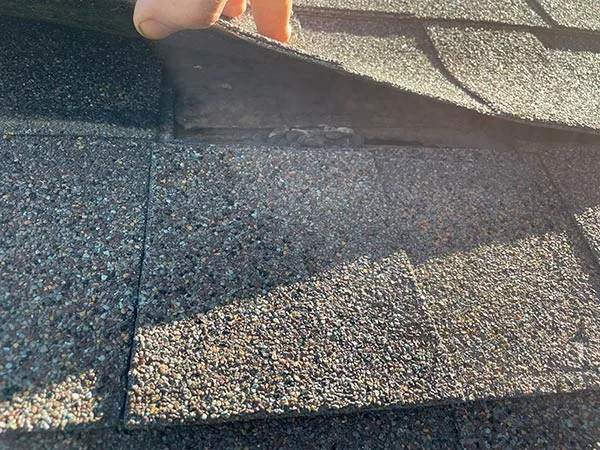
Jeremy lifts tabs along the windward slope, gently, to see whether the sealant strip is still holding, the way the edge in the photo shows. A tab that comes up with no resistance has lost its bond. One or two can be resealed by hand. A whole slope of them is a different conversation.
What a slope repair involves
On a repair, the damaged shingles come off along with the ones lapping over them, and the underlayment and deck beneath get checked for punctures or soft spots. New IKO shingles go into the same courses in the closest match available, nailed on the nail line and sealed down. Any dented vent or cracked boot collar on that slope is swapped in the same visit, so the slope is finished when we leave.
Repair, replace, or leave it alone
There are three honest outcomes. Scattered damage on one slope is often a repair: the damaged shingles come out, new ones go in, and the seal lines get restored. Bruising across every slope means replacement makes more sense than patching the same roof twice. And plenty of roofs need nothing, which is exactly what you will hear when that is the case.
Photos first, paperwork second
Every slope gets photographed before a single shingle moves, with the dented vents and gutters in the same set. If the damage is real, those photos are the start of your claim, and insurance claims in West Valley City walks through what happens next. If a leak has already started, it gets dried in first.
Hail Rarely Stops at the Shingle Field
Low-slope additions, carports and patio covers take stones flat-on, and a membrane or coating can crack or puncture where a pitched slope would shed the hit. Damage on those sections is covered on the flat roofing page for West Valley City.
A box vent that came away dented sometimes came away cracked, and a cracked vent leaks into the attic long before a ceiling shows it. If vents need replacing anyway, it is worth asking whether the attic was vented properly to begin with, and roof ventilation in West Valley City explains how we sort that out.
Attached homes are their own case, since one squall damages a roof several owners share. The townhome roof repair page covers how that gets handled without leaving one section mismatched. Gutters come last: a dented gutter can still drain, and one pulled loose cannot. Jeremy tells you which kind you have.
The Person Who Climbs It Is the Person Who Fixes It
Royal Dane Roofing is not the biggest roofer in Salt Lake County, and after a hailstorm that is the point. Jeremy handles the free assessment on the roof with a camera, and the person who tells you what the hail did is the one responsible for repairing it. No salesman, and no crew passing through from out of state.
He would rather tell you the roof came through fine than sell you one you do not need. When it did not, you see the photos and get a firm written number before any work starts. Active leaks come first after a storm, and dry roofs with dents are booked in the order the calls came in.
More often than not, a hail roof here is also an older roof. If the shingles were already near the end, Jeremy says so separately from the storm damage, so you can plan with an honest picture instead of a sales pitch.
Our West Valley City page has the rest of our work in town, and finished roofs are in the gallery. Use the contact page or call (801) 750-4243 to set a time.
Asked After Nearly Every Hailstorm
How do I know if hail damaged my roof?
Look at the soft metal before the shingles. Dents in box vents, gutters, downspouts or the metal collars around pipe boots mean stones big enough to matter hit the house. Shingle bruising is rarely visible from the ground, so an on-roof look with photos is the only reliable answer.
Is granule loss after hail the same as damage?
Not always. Every roof sheds some granules, and new shingles lose loose ones early on. Hail loss shows as distinct bare spots where a stone struck, often with a soft bruise underneath. Thin coverage spread evenly across an old roof usually points to age, not the storm.
Can I wait to see if my roof starts leaking?
You can, but hail damage seldom leaks right away. A bruised shingle cracks through slowly, and an unsealed tab may hold until the next strong wind. Waiting also uses up time on your policy’s reporting window, and having the roof looked at early costs you nothing.
Does hail on one slope mean a whole new roof?
Not by itself. Damage confined to the slope that faced the storm is often a repair. Replacement makes sense when bruising is spread across most of the roof, or when the shingles were near the end of their life already. Jeremy shows you photos of every slope.
How well does an older three-tab roof hold up to hail?
Not as well as a newer architectural shingle. Three-tab is thinner, and older three-tab has usually lost the flexibility it had new, so it bruises and cracks more easily. Many starter-home roofs in this part of the valley still carry it, which makes a hail check worth doing.
Should I call my insurance company or a roofer first?
Roofer first, in most cases, because getting the roof photographed first means you know what you are reporting. Jeremy documents the damage before anything is touched and tells you plainly whether it looks like storm damage at all. If it does, those photos go with your claim.
A Dent Is a Question, Not a Verdict
Jeremy will check the metal, read every slope, lift the tabs on the windward side and tell you whether you are looking at a repair, a replacement or nothing at all. The roof assessment costs nothing, the photos are yours to keep, and any price comes on paper. If the squall missed you entirely, that is worth knowing too, and plenty of people get exactly that answer.
